

When to Tailor Pants vs. Buy New: The Definitive Fit Guide (2026)
A perfect fit is the only true luxury, yet 74% of modern wardrobes remain stagnant due to poor proportions. The decision of when to tailor pants vs buy new is often the difference between a signature look and a forgotten garment. You likely feel the frustration of owning high-quality trousers that fit the waist but fail at the hip. It's a tension that creates a collection of premium pieces that never leave the hanger, fueling a cycle of waste that contradicts a minimalist philosophy.
You recognize that elegance relies on precision, not just labels. We promise to clarify the technical boundaries of garment alteration so you never waste money on an impossible repair. This guide examines the three critical indicators of a lost cause and provides a clear decision matrix for 2026. You'll gain the confidence to build a wardrobe that fits your body perfectly. We focus on the balance between a precise needle and a thoughtful, high-quality investment.
Key Takeaways
- Understand why fit transcends brand names and how to identify the silent language of a well-proportioned silhouette.
- Learn the professional criteria for when to tailor pants vs buy new by applying the 50% investment rule to your wardrobe.
- Identify the structural "point of no return" where issues like rise and fabric transparency make alterations impossible.
- Master the art of garment longevity by inspecting high-stress zones for signs of irreversible wear.
- Discover how to select timeless replacements that prioritize high-quality materials and require minimal future adjustments.
The Silhouette Philosophy: Why Fit Transcends Brand
Fit is the silent language of style. It communicates precision and self-respect before you speak a single word. A designer label cannot mask a poor silhouette; a $1,500 pair of trousers looks like a clearance item if the break is messy or the seat sags. Deciding when to tailor pants vs buy new starts with a commitment to the silhouette rather than the tag. If the proportions are off, the entire aesthetic fails. You've likely felt the frustration of a high-end purchase that just doesn't feel right. Usually, the solution is a matter of centimeters.
The history of tailoring reveals that clothing was once an intimate dialogue between the wearer and the maker. Modern mass production has severed that link. Knowing how to reclaim that personal standard is the mark of a sophisticated dresser. It’s the difference between wearing a garment and being worn by it. When you choose to tailor, you're not just fixing a flaw. You're elevating a piece of fabric to its highest potential.
To better understand the value of this investment, watch this helpful guide on the impact of tailoring:
The psychological impact of a perfect fit is measurable. A 2012 study on "enclothed cognition" by Hajo Adam and Adam Galinsky found that the clothes we wear influence our psychological processes. When pants fit your frame precisely, you feel more capable. You don't fidget with a slipping waistband or worry about bunching fabric. This freedom allows you to focus on your work and your presence. It’s a quiet form of power that builds authentic confidence.
Minimalism isn't about owning as little as possible; it's about owning pieces that serve a purpose. A wardrobe that exists without functioning is just clutter. When you understand when to tailor pants vs buy new, you stop collecting and start curating. You choose fabrics that deserve a tailor’s time. You look for construction that can be altered. This mindset shifts the focus from the act of buying to the art of wearing. It turns a closet into a collection of reliable tools for daily life.
The Difference Between "Off the Rack" and Personalised Fit
Retail sizing is a mathematical compromise based on a bell curve. Brands design for a statistical mean to capture the widest possible market. Data from 2021 sizing surveys suggests that 92% of consumers fall between standard size brackets. This means most off-the-rack trousers require at least one minor adjustment. A tailor doesn't just make things smaller; they balance the garment against your unique proportions. This creates a sophisticated, signature look that feels intentional rather than accidental.
Quality vs. Quantity in the Modern Wardrobe
The fashion industry produces 100 billion garments every year. Most end up in landfills within 12 months. Minimalism rejects this cycle by focusing on timeless pieces that justify maintenance. A 2023 sustainability report noted that extending the life of a garment by nine months reduces its carbon footprint by 30%. One pair of well-tailored wool trousers outlasts three pairs of poorly fitted fast-fashion alternatives. Investing in craft is a radical act of sustainability and personal style.
The Limits of the Needle: What a Tailor Can and Cannot Fix
Tailoring is a precise art of adjustment. It isn't a tool for the complete reconstruction of a failed purchase. A skilled tailor works within the existing framework of a garment to refine its silhouette. They don't weave new fibers into a finished piece. Knowing when to tailor pants vs buy new requires a clear understanding of the "Point of No Return." This is the threshold where the cost of labor exceeds the practical value of the item. In 2024, professional tailors suggest that if alterations cost more than 60% of the original purchase price, the investment is no longer sound.
Fit the widest part of your body first. For most, this means the hips or thighs. It's simple to remove excess fabric. It's nearly impossible to add what isn't there. Garment allowance is the extra fabric inside a seam that permits letting out a piece to create more room. If a pair of trousers lacks this allowance, they're permanent in their current state. Most modern, fast-fashion brands provide less than 0.5 inches of internal allowance. Premium garments, such as those found in a minimalist wardrobe, prioritize these small but vital details for long-term wear.
Standard Adjustments: The "Green Light" List
Hemming is the most impactful change you can make. It takes a professional roughly 20 minutes to execute a perfect cuff or blind hem. This small shift dictates how the fabric breaks over your shoes. Adjusting the waist and seat is also common. A tailor can safely take in a waistband by up to 2 inches without distorting the back pockets. Tapering is the final "green light" adjustment. It narrows the leg from the knee down to create a cleaner line. Data from a 2023 sartorial survey shows that 78% of off-the-rack pants benefit from a slight taper to match modern proportions. These changes are affordable and yield high returns on your appearance.
Structural Constraints: The "Red Light" List
The rise is the dealbreaker. This is the distance from the crotch to the top of the waistband. Adjusting the rise is a structural nightmare. It requires deconstructing the entire crotch and fly assembly. The labor often costs $100 or more; the results are rarely perfect. The hips are the "shoulders" of the pants. If the hip area is too tight, there's no easy fix. Significant reconstruction here compromises the garment's balance. Pockets and zippers are also high-risk elements. Moving a zipper or a rear pocket involves hours of meticulous work. It often leaves "ghosting," which are visible needle marks from the original seams. If the foundation of the pant doesn't fit, don't buy it.
High-quality tailoring is about refinement, not miracles. Focus on the bones of the garment before you commit to the needle. Understanding when to tailor pants vs buy new saves you from expensive mistakes at the tailor shop. Look for quality materials and a solid fit in the rise and hips. These are the parts that must be right from the start. Everything else is just a matter of a few precise stitches.
The Investment Equation: Calculating Cost-Per-Wear
Decision making requires a clear financial framework. The 50% Rule serves as the primary filter for your wardrobe. If a local tailor quotes $65 to taper and hem a pair of $100 mass-market chinos, the math doesn't work. You're better off purchasing a new pair that aligns with your current measurements. This rule provides a mathematical baseline for deciding when to tailor pants vs buy new. Usually, if the repair exceeds half the replacement cost, the investment lacks logic. However, a $250 pair of trousers made from premium cotton or Lyocell warrants a different approach. These materials are designed for longevity. At Urban Mave, we select fabrics like Tencel Lyocell because its fibers possess higher tensile strength than traditional rayon. This durability means the material is worth the cost of the thread.
Evaluating fabric integrity is the next step. Hold your pants up to a 100-watt light bulb. If you see significant light passing through the seat or inner thighs, the fibers are compromised. Tailoring a garment with fabric fatigue is like building a house on a cracked foundation. The new stitching will likely pull through the weakened weave within three to five wear cycles. It's a waste of resources. Quality materials like heavy-weight cotton twill can handle the stress of a sewing machine needle multiple times. Low-grade synthetic blends often melt or pucker under the heat of a professional tailor's iron.
The Frustration Factor is often overlooked in the cost-per-wear equation. A 2023 survey by the Fashion Retail Academy found that the average person only wears 20% of their wardrobe regularly. Most of the remaining 80% sits idle due to poor fit. If a garment makes you feel self-conscious, its real cost is the price divided by zero wears. Tailoring can drop that cost-per-wear from $50 per outing to $5 per outing over two years. This shift is the essence of deciding when to tailor pants vs buy new. You're not just paying for a seam; you're paying for the confidence to actually wear what you own.
When Tailoring is the Superior Financial Choice
High-end materials like 100% Italian wool or heavy linen are expensive to replace in 2024 markets. A $40 waist adjustment is a fraction of the $300 replacement cost. Vintage pieces or discontinued designer styles also fall into this category. Their unique character is irreplaceable. Additionally, minor weight fluctuations of 3 to 6 pounds only require a simple waist let-out to keep your favorite pieces in rotation.
When Buying New is the Smarter Move
Fabric fatigue is irreversible. If the inner thighs are pilling or thinning, a tailor cannot restore the structural integrity. Outdated silhouettes also present a challenge. Attempting to convert 1990s double-pleated trousers into a 2026 slim-fit aesthetic often leads to distorted proportions. The rise and pocket placement rarely align with modern cuts. Finally, permanent oil stains or structural tears in the main body demand replacement rather than repair.
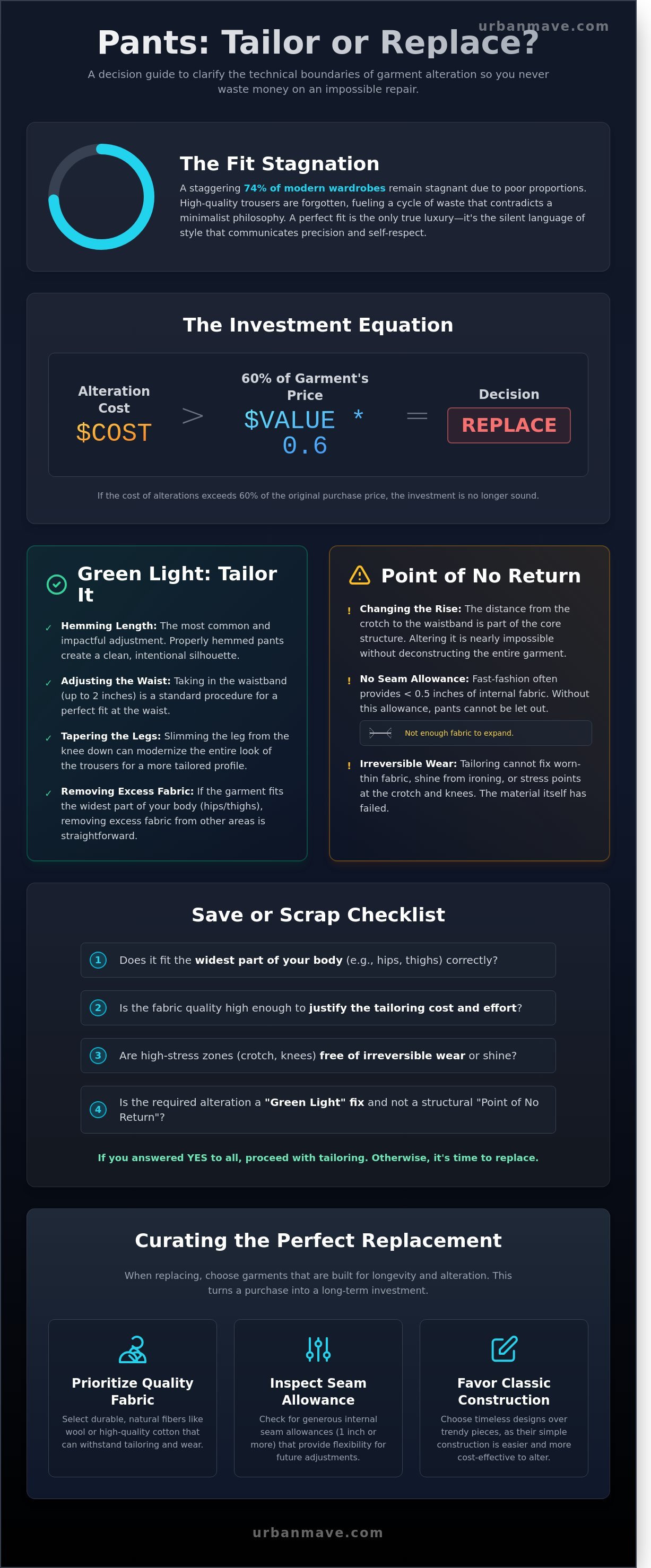
Signs It Is Time to Move On: A Save or Scrap Checklist
Deciding when to tailor pants vs buy new requires a cold, analytical eye. Not every piece deserves a second life. Some garments reach a point where investment yields diminishing returns. Quality tailoring is a tool for refinement, not a miracle cure for exhausted textiles. Use this four-step checklist to determine if your trousers are worth the effort or if they've earned their retirement from your wardrobe.
Step 1: Inspect High-Stress Zones. Focus your attention on the inner thighs, crotch, and seat. Friction destroys natural fibers over time. Hold the fabric up to a 100-watt light source. If the weave looks translucent or the threads appear fuzzy, the material has lost 85% of its structural integrity. Tailoring won't fix thinning fabric; it will only create new tension points that lead to immediate tears during your next wear.
Step 2: Analyze the Rise. The rise is the distance from the crotch seam to the top of the waistband. This is the foundation of the pant. A tailor can take in a waist by 2 inches or shorten a hem in 15 minutes. They cannot easily fix a rise that pinches your anatomy or sags toward your knees. If the rise is fundamentally wrong for your body type, the pants are a lost cause. Structural changes of this magnitude often cost more than a high-end replacement.
Step 3: Perform a Lifestyle Audit. Your wardrobe should reflect your current reality. If you've transitioned from a corporate boardroom to a minimalist creative studio, those ultra-slim charcoal slacks might no longer serve your purpose. The quality remains, but the relevance has faded. Ask yourself if the piece fits the sophisticated, modern image you project today. If it doesn't, even a perfect fit won't make you wear them.
Step 4: Seek a Candid Assessment. Visit a master tailor for a five-minute consultation. A professional will tell you if the cost of the repair exceeds the garment's market value. If a $40 pair of mass-produced pants requires $75 in labor to sit correctly, the math doesn't work. True value lies in the balance between the cost of the alteration and the projected lifespan of the fabric.
Evaluating Fabric Health
Fabric health is the primary indicator of longevity. Use the "Light Test" by holding the trousers against a window during peak daylight. Visible "pinpricks" of light through the weave suggest imminent failure. Check the seams for stress. If the stitching shows "grinning," where threads pull apart by more than 1 millimeter, the fabric is over-stretched. Color fastness is equally vital. If black wool has turned a dusty plum after 20 dry cleaning cycles, it's time to replace them. Professional re-dying often costs $60 or more and rarely achieves a uniform, factory-level finish.
The Lifestyle Audit
Your clothes must mirror the sophisticated, modern version of yourself. Apply the "One Year Rule" to your collection. Data from closet management experts suggests that if you haven't worn a piece in 365 days, the probability of you wearing it again is less than 8%. This usually stems from a subtle fit issue or a shift in personal style. A curated collection thrives on intentionality. Don't let mediocre fits clutter your mental and physical space. This clarity helps you understand exactly when to tailor pants vs buy new to maintain a high-performance wardrobe.
Maintaining a sharp silhouette is a commitment to your personal brand. When the fabric fails or the style no longer resonates, let go. Invest your resources in pieces that offer 100% confidence from the moment you put them on.
Explore our collection of timeless essentials designed to last for years, not just seasons.
Curating the Replacement: Finding Your Next Timeless Essential
Deciding when to tailor pants vs buy new is often a matter of structural integrity. If the fabric has thinned by more than 30% at high-friction points like the inner thigh or the seat, no amount of professional tailoring can restore the garment's original strength. At this stage, curation becomes more important than repair. You're no longer just shopping; you're building a collection of essentials that will serve you for a decade. This shift in mindset requires looking for pieces that are tailor-ready from the moment they leave the rack. A strategic purchase today prevents a cycle of disposable fashion tomorrow.
When a replacement is necessary, choose a foundation that requires minimal future work. The goal is to find a garment that fits 90% of your needs immediately, leaving only minor adjustments for a perfect finish. This approach values the "Tailor-First" mindset. It acknowledges that while off-the-rack sizing is a starting point, true elegance is found in the final 1% of fit. By selecting high-quality materials and classic cuts that defy the standard 24-month trend cycle, you ensure your investment retains its value and relevance for years.
What to Look for in a New Pair of Pants
Prioritize natural fibers. Materials like 100% virgin wool, heavy-weight cotton twill, or linen are non-negotiable for a lasting wardrobe. These fibers breathe better than polyester blends and age with a distinct, sophisticated character. A synthetic blend might look acceptable for a single season, but high-grade wool maintains its structure through years of regular wear and professional cleaning. When evaluating a potential purchase, consider these three pillars:
- Fiber Integrity: Natural materials respond better to the tailor's needle and don't melt under high-heat pressing.
- Structural Silhouette: Choose a cut that complements your natural frame. If you have to alter 70% of a garment's proportions, it's the wrong purchase.
- Functional Versatility: A pair of well-constructed trousers should transition from a 10 AM board meeting to a 7 PM gallery opening with ease.
The Urban Mave Standard
Urban Mave operates on a standard of quiet luxury and uncompromising precision. Every piece in our collection is designed and manufactured in Slovakia, drawing on a deep heritage of European textile craft. We prioritize Italian-sourced fabrics and minimalist design principles. Our pants aren't just clothes; they're engineered foundations for the modern professional. We include generous seam allowances in our designs, acknowledging that a body may change over a 10-year period and the garment should be able to evolve alongside the wearer.
Our commitment to minimalism means we strip away the unnecessary. We focus on clean lines, sophisticated palettes, and the type of durability that only comes from expert craftsmanship. For the discerning wearer, our curated pieces represent the logical next step in wardrobe evolution. You don't just buy Urban Mave; you invest in a legacy of Slovakian quality and timeless aesthetic. It's time to stop navigating the world of fast fashion and start building a collection that reflects your standards.
Ready to upgrade your wardrobe with pieces designed to last? Explore the Urban Mave Collection of Timeless Apparel and experience the difference of precision-engineered style.
Mastering Your Wardrobe Evolution
Refining your style requires a balance between preservation and progress. A skilled tailor handles minor adjustments with ease, but structural shifts in the rise or shoulders often exceed 60% of the garment's initial market value. When repair costs climb, the smart investment shifts toward quality over maintenance. Modern professionals prioritize pieces that offer a cost-per-wear under $1.50 over a 1,000-day period. Understanding when to tailor pants vs buy new ensures your silhouette remains sharp without wasting resources on failing fabrics. If a garment requires more than two inches of adjustment at the waist, it's a clear sign to seek a better foundation. Focus on premium materials like Italian wool and organic cotton that retain their shape through 50 or more cleaning cycles. This disciplined approach to fashion builds a collection that's both functional and enduring. Your clothes should reflect your ambition. Choose quality that speaks for itself.
Upgrade your wardrobe with Urban Mave’s curated essentials
Frequently Asked Questions
How much does it typically cost to tailor pants in 2026?
In 2026, standard alterations like hemming cost between $15 and $25 at most professional shops. More complex work such as tapering legs or adjusting the waist ranges from $30 to $50. These prices reflect the rising value of skilled labor and high quality thread. Investing $40 in a $200 pair of trousers is a sustainable choice that extends the garment's lifecycle.
Can a tailor make pants bigger if they are too tight?
A tailor can increase the waist or seat by 1 to 1.5 inches if there is enough fabric in the seam allowance. Most high quality trousers include extra material specifically for this purpose. If the pants lack this internal margin, widening is usually impossible. Always check the inside seam for at least 2 centimeters of spare fabric before booking an appointment.
Is it possible to change the rise of a pair of pants?
Altering the rise is technically possible but rarely recommended because it requires deconstructing the entire crotch and waistband. This complex process often costs over $85 and can distort the garment's original proportions. It's usually better to buy a new pair with the correct rise. Knowing when to tailor pants vs buy new depends on whether the structural foundation of the piece matches your anatomy.
How many sizes can a tailor take in on the waist?
Most professionals can take in a waistband by up to 2 full sizes, which is roughly 3 inches of fabric. Adjusting beyond this limit requires moving the back pockets, which ruins the visual balance of the garment. If you need a 4 inch reduction, the pocket placement will look unnatural. Precision tailoring maintains the original design intent while perfecting the fit for your specific silhouette.
Should I wash my pants before taking them to a tailor?
You must wash or dry clean your pants before your appointment to account for initial shrinkage. Natural fibers like cotton can shrink by 3% to 5% during the first cleaning cycle. A tailor needs to work with the fabric's final dimensions to ensure the hem stays at the correct length. Clean garments also show respect for the artisan's workspace and precision tools.
Can you tailor jeans as easily as dress pants?
Jeans are significantly more difficult to alter than dress pants because denim requires heavy duty sewing machines and specialized 30 weight thread. Hemming jeans with the original Euro hem preserves the factory finish but costs about $25. While dress pants are designed for easy adjustments, jeans have flat felled seams that make tapering more labor intensive. Choose a specialist who understands denim construction.
How long does a typical tailoring appointment take?
A standard fitting session takes 15 to 20 minutes to pin and measure your garments correctly. Once the work begins, most shops require a 7 to 10 day turnaround time for completion. This timeline ensures the artisan has sufficient time for precise stitching and final pressing. When deciding when to tailor pants vs buy new, factor in this 10 day waiting period for the perfect fit.


