

What is Sustainable Fashion? A Comprehensive Guide for the Modern Wardrobe
True style has nothing to do with passing trends. It is defined by permanence and quality. With over 100 billion new garments produced annually, the pressure to consume is relentless, leaving a trail of waste and confusion. It’s easy to feel overwhelmed by contradictory eco-labels and wonder if sustainable clothing can truly possess the elegance you seek.
This guide provides clarity. It offers a direct answer to what is sustainable fashion and presents a clear path toward curating a sophisticated, ethical wardrobe. We will explore the core principles of sustainability, identify the characteristics of superior, long-lasting materials, and outline a simple philosophy for investing in pieces designed to last a lifetime, not just a season.
Key Takeaways
- Understand precisely what is sustainable fashion by examining its three core pillars, from environmental impact to ethical production.
- Discover how to assess a brand's integrity by tracing its supply chain and understanding its role in the circular economy.
- Learn why material selection is crucial and explore innovative fabrics like Lyocell that define modern, responsible design.
- Master the art of curating a timeless wardrobe with a simple guide to auditing your pieces and defining your personal uniform.
Defining Sustainable Fashion: The Three Pillars of Modern Integrity
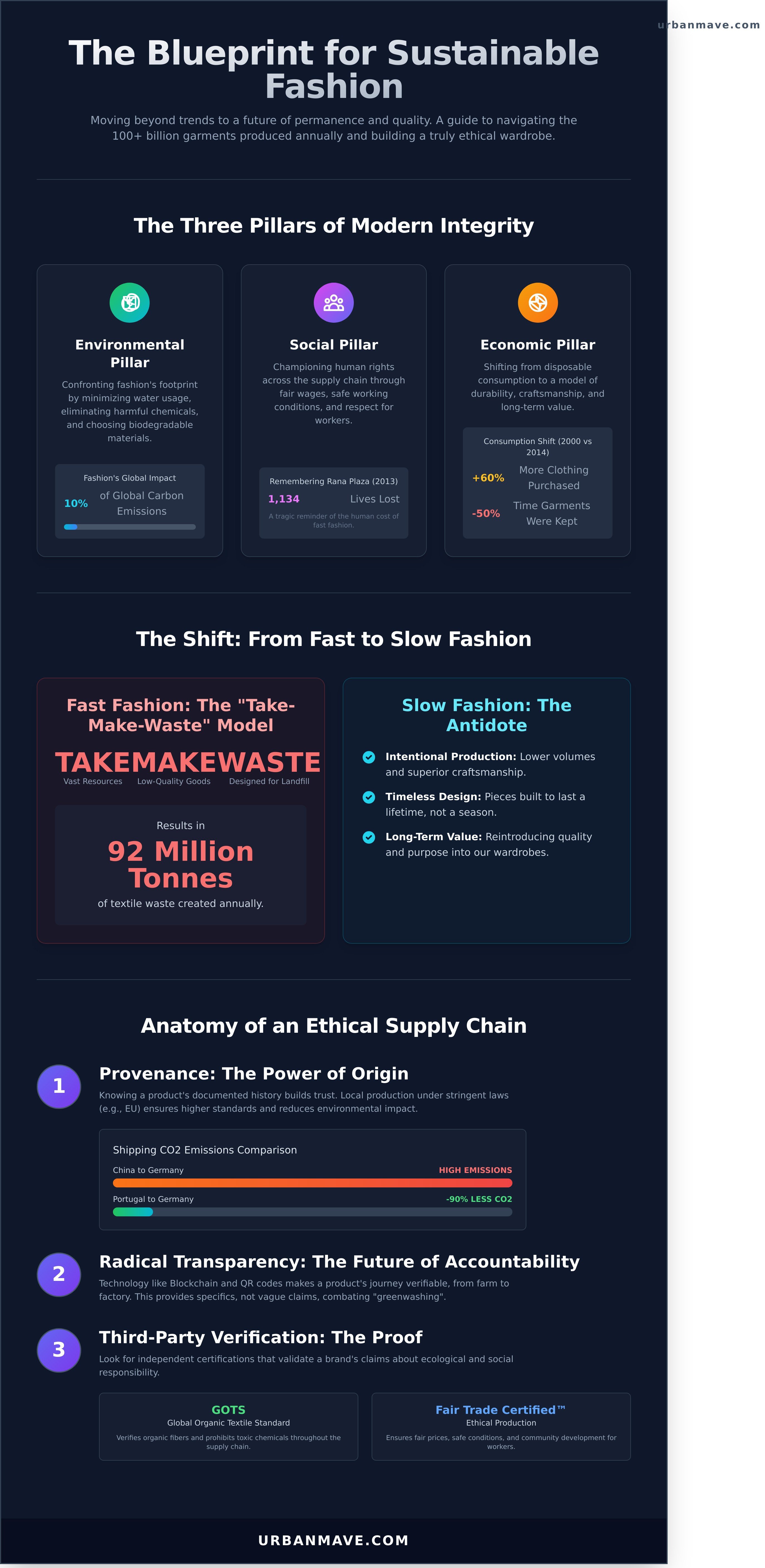
Answering the question of what is sustainable fashion requires looking beyond a single material or marketing claim. It is a comprehensive approach to designing, sourcing, and manufacturing clothing. The goal is simple: to maximize positive impacts on both people and the planet. This philosophy is built upon three foundational pillars that define modern integrity in the apparel industry.
True sustainability is not a single action but a balanced system. Each pillar supports the others, creating a framework for quality, responsibility, and timeless value. Understanding this structure is the first step toward making more conscious choices.
- The Environmental Pillar: The fashion industry is responsible for up to 10% of global carbon emissions and is the second-largest consumer of the world's water supply. A sustainable approach directly confronts this by minimizing its footprint. This includes using less water, eliminating harmful chemical dyes, and choosing natural, biodegradable materials that don't pollute our ecosystems.
- The Social Pillar: A garment’s story includes the hands that made it. This pillar focuses on human rights across the entire supply chain. It demands fair wages, safe working conditions, and the right to unionize. The 2013 Rana Plaza factory collapse, which cost 1,134 lives, served as a tragic reminder that the human cost of cheap clothing is unacceptable.
- The Economic Pillar: This represents a deliberate shift away from the disposable model of consumption. Consumers in 2014 bought 60% more clothing than in 2000 but kept each item for half as long. The economic pillar of sustainability promotes durability, craftsmanship, and long-term value, creating pieces designed to last for years, not just a season.
Beyond the Buzzwords: Ethics vs. Eco-Friendly
The terms are not interchangeable. 'Eco-friendly' addresses planetary health-reduced emissions, clean water, and non-toxic materials. 'Ethical' addresses human well-being-fair labor and safe environments. By 2026, a brand that addresses only one cannot be considered truly sustainable. Urban Mave integrates these concepts into a singular philosophy of quiet excellence. It’s a standard, not an option.
The Shift from Fast Fashion to Slow Fashion
The traditional industry operates on a "take-make-waste" model, producing vast quantities of low-quality goods designed for obsolescence. The Slow Fashion movement is the direct antidote. It champions intentionally lower production volumes and superior craftsmanship. This movement, a core component of Sustainable fashion, reintroduces value into our wardrobes. Ultimately, timeless design is the most effective tool against the 92 million tonnes of textile waste created annually.
The Anatomy of an Ethical Supply Chain
A garment’s story doesn't begin on the rack. It begins with a seed, a thread, and a pair of hands. An ethical supply chain is the transparent narrative of that journey. It moves beyond materials to focus on the people, processes, and principles behind a finished piece. Understanding this chain is essential if you're asking, what is sustainable fashion? It requires a commitment to traceability, from the raw fiber to the final, precise stitch.
The Importance of Provenance
Provenance is the documented history of a product’s origin and ownership. This knowledge builds trust. The "Made in Europe" label, for instance, often correlates with higher standards because it operates under stringent EU labour laws, such as the 2003 Working Time Directive, which regulates working hours and paid leave. Local production also reduces a garment's carbon footprint. Shipping a piece from Portugal to Germany emits up to 90% less CO2 than shipping the same item from China. This connection between artisanal skill and proximity ensures a garment is not only made ethically but built for longevity.
Radical Transparency in 2026
Technology is making provenance verifiable. By 2026, technologies like blockchain are projected to secure over $10 billion in goods across global supply chains, creating immutable records of a product's journey. A simple QR code scan can reveal the organic cotton farm in Turkey, the Italian tannery, and the Slovakian workshop where a piece was assembled. This is the future of accountability.
At Urban Mave, our approach is built on fewer partners and deeper relationships. We work directly with a select group of European factories, ensuring our uncompromising standards for quality and ethics are met. This direct oversight is not a feature; it is our foundation.
This level of detail is the antidote to "greenwashing," where brands use vague claims like "eco-friendly" without proof. True transparency offers specifics: the factory’s name, its certifications, and the exact material composition. You should look for third-party verification, not just a brand’s word.
Key certifications provide this proof:
- GOTS (Global Organic Textile Standard): This is the leading standard for organic fibers. It verifies that the entire textile supply chain meets strict ecological and social criteria, prohibiting the use of toxic heavy metals, formaldehyde, and other hazardous chemicals.
- Fair Trade Certified™: This certification focuses on people. It guarantees that workers receive fair wages, operate in safe conditions, and benefit from a Community Development Fund, empowering them to invest in local projects.
The supply chain begins with the designer. The decision of which factory to partner with is as critical as the choice of fabric. Selecting a workshop that shares a commitment to precision and ethical practices is the first, non-negotiable step. This philosophy is a core part of the definition of sustainable fashion. An ethical supply chain is not a marketing trend; it is the very structure of a modern, responsible brand. Discover how we build our products through our own transparent process.
Environmental Impact: From Carbon to Circularity
The true cost of fashion is not on the price tag. It's measured in consumed resources and environmental degradation. According to the UN Environment Programme, the industry is responsible for up to 10% of global carbon emissions. It also accounts for a staggering 20% of global wastewater. This impact extends into our oceans, where the International Union for Conservation of Nature (IUCN) estimates that 35% of all primary microplastics polluting marine environments come from washing synthetic textiles like polyester.
Addressing this requires a systemic shift. It demands moving beyond a linear model of production to one that is restorative and regenerative by design. Understanding this shift is central to answering the question of what is sustainable fashion. It’s about rethinking the entire lifecycle of a garment, from the soil where a fiber grows to its eventual return to the earth.
The Circular Fashion Framework
A circular economy is the antithesis of "fast fashion." It’s a model built on three principles: eliminate waste, circulate products and materials, and regenerate nature. For fashion, this means designing for longevity. It means creating timeless pieces from high-quality materials that withstand years of wear. The "end of life" problem is a critical challenge; the Ellen MacArthur Foundation reports that less than 1% of material used for clothing is recycled into new garments. Urban Mave’s commitment is to natural, biodegradable materials. Quality leather and linen can return to the earth, unlike synthetics which persist in landfills for centuries.
Waste Reduction Strategies
Innovation is key to minimizing fashion’s footprint. One significant strategy involves repurposing "deadstock" fabrics-the leftover materials from larger production runs. Platforms like LVMH-backed Nona Source now allow designers to acquire and use these high-quality textiles, preventing them from becoming waste. Advanced technologies are also transforming production. Waterless dyeing techniques, such as Dyecoo's CO2-based process, eliminate water usage and chemical runoff, protecting local ecosystems. A transparent sustainable fashion industry supply chain is essential for brands to verify these methods. Finally, minimalist collections inherently reduce waste by sidestepping the trend cycle, which decreases overproduction and the need for seasonal clearance.
The focus on sustainability now extends to the very source of our materials. Regenerative agriculture offers a path for farming to become a climate solution. Practices for growing fibers like cotton and linen can restore soil health, improve biodiversity, and actively sequester carbon from the atmosphere. Certifications like Regenerative Organic Certified® are setting a new standard for raw material sourcing.
Even the final details matter. Packaging, which accounts for a significant portion of global plastic waste, is a brand’s last touchpoint. The shift is toward materials that are recycled, recyclable, or home-compostable. FSC-certified paper and minimal designs replace virgin plastics. Every choice, from fiber to finishing, defines a brand's environmental commitment.
The Fabric of the Future: Lyocell, Organic Cotton, and Beyond
The integrity of a garment begins with its material. This single choice dictates its environmental footprint, its feel against the skin, and its longevity. A design built on a poor foundation cannot be sustainable. It's why material science is the most critical element in creating responsible, timeless fashion.
The search for better materials has led to remarkable innovations. Some revive ancient practices, while others leverage modern technology to create fibers that are both beautiful and benign. These materials are not compromises; they are upgrades.
Lyocell: The Sophisticated Choice
Lyocell represents the pinnacle of modern fiber technology. Produced from the wood pulp of sustainably managed forests, its creation is a masterclass in efficiency. The process is a closed-loop system, where over 99% of the non-toxic solvent is captured and reused. This circular method minimizes waste and water usage. The result, often known by the brand name Tencel™, is a fabric with a fluid, silk-like drape, exceptional breathability, and impressive moisture-wicking properties. For a detailed exploration of its benefits, consult our complete Lyocell Guide.
Organic cotton presents a more complex picture. Its primary advantage is water conservation. According to the Textile Exchange, its cultivation can use up to 91% less "blue" water from groundwater and surface sources than conventional cotton. It also eliminates the use of synthetic pesticides and fertilizers, protecting soil health and farm workers. The challenge, however, lies in its yield. Organic farms can sometimes produce 20-30% less cotton per acre, a reality that requires a thoughtful approach to sourcing and supply chains.
Beyond these mainstays, a new generation of materials is emerging. Innovators are developing mushroom leather (mycelium), seaweed-infused fibers, and even textiles from citrus fruit byproducts. These advancements signal a future where our clothing is derived from regenerative sources.
Natural vs. Synthetic: A Performance Comparison
The debate between natural and synthetic fibers is central to understanding what is sustainable fashion. Natural materials like cotton, linen, and wool work in harmony with the body. They breathe, manage moisture, and help regulate temperature. Synthetics, derived from petroleum, often trap heat and moisture. They also lack the graceful aging process of their natural counterparts. A linen shirt softens with wear; a polyester one pills and loses its shape.
The issue of "recycled polyester" warrants scrutiny. While it diverts plastic bottles from landfills, it doesn't solve the fundamental problem of microplastics. A 2016 study from Plymouth University found that a single 6kg wash load can release an estimated 700,000 synthetic microfibers into our waterways. These particles persist indefinitely, contaminating ecosystems. Choosing natural fibers is a direct action against this form of pollution.
Our commitment to superior, natural materials is uncompromising. Explore our collection of timeless pieces crafted for longevity.
Curating a Sustainable Wardrobe: The Minimalist’s Guide
Understanding what is sustainable fashion in theory is one step. Applying it is another. A curated wardrobe moves beyond fleeting trends to embrace a philosophy of intention. It is not about restriction; it is about liberation from the cycle of consumption. The process involves five deliberate steps toward a more refined and responsible style.
Begin with a wardrobe audit. Systematically review every item you own. Identify the pieces you have worn more than 30 times. These are your foundational, "forever" garments. The rest represent an opportunity for change. Items that no longer serve you can be sold, donated, or responsibly recycled, clearing space for a more intentional collection.
Next, define your personal uniform. This is your signature aesthetic, a consistent style that reflects your identity. A well-defined uniform acts as a filter, protecting you from the impulse to buy into fast fashion's 52 micro-seasons. It simplifies daily decisions and ensures every piece you own has a purpose. Your style becomes a conscious choice, not a reaction to marketing.
Prioritize quality over quantity. This is a fundamental principle of sustainable living. Consider the economics: a single, high-end knit polo for $200, worn 100 times over five years, has a cost-per-wear of $2. In contrast, five cheap tees at $30 each might last only 10 washes. That's a total investment of $150 for just 50 wears, a cost-per-wear of $3, and five times the textile waste. The superior choice is clear.
The Power of the Capsule Wardrobe
A capsule wardrobe is the ultimate expression of minimalism. With just 15 meticulously chosen pieces, it’s possible to create over 50 unique outfits. The foundation rests on a versatile color palette: navy, charcoal, cream, and black. These tones provide a sophisticated canvas for any occasion. Mastering these combinations is simple with the right inspiration. You can explore practical examples in The Smart Casual Edit.
Mastering garment care is essential to protect your investments. Simple habits extend the life of your clothing for years.
- Wash Cold: Use cold water to reduce energy consumption by up to 90% and prevent fiber degradation.
- Air-Dry: Avoid high-heat dryers, which shrink and weaken natural fabrics. Lay knits flat to retain their shape.
- Mend Promptly: A loose thread or a lost button is a simple fix, not a reason to discard a quality garment.
Finally, support brands that align with your values. Choose designers who prioritize timeless sophistication and transparent craftsmanship. This is the most direct way to build a wardrobe that is not only stylish but also ethically sound. It’s the practical answer to the question of what is sustainable fashion in our daily lives.
Investing in Craftsmanship
Discerning quality is a skill. Look for dense stitching, with 8-12 stitches per inch on a quality shirt. Inspect the seams; French or flat-felled seams are a mark of durability, while simple overlocked edges are not. The hardware, from zippers to buttons, should feel substantial and solid. This attention to detail defines the return on investment of a luxury garment. It is built to last.
Your wardrobe is a collection of personal assets. Begin building yours with pieces that reflect a commitment to quality and longevity. Discover the Urban Mave Collection and start your journey toward a curated, sustainable lifestyle.
Defining Your Sustainable Style
Moving beyond trends is the true essence of modern style. It’s a commitment to understanding the anatomy of your wardrobe, from an ethical supply chain to the carbon footprint of each garment. By choosing superior fabrics like TENCEL™ Lyocell, which can use up to 50% less water than conventional cotton, you actively participate in a more circular economy. This isn't about restriction; it's about intentionality and the power of a minimalist approach.
Ultimately, the answer to what is sustainable fashion lies not in a complex definition, but in a simple philosophy: invest in pieces that last. At Urban Mave, we believe in this principle. Our focus is on timeless craftsmanship and high-quality natural materials, resulting in a selection of handpicked designer goods created for a lifetime, not just a season.
Begin your journey with pieces that reflect your values. Explore our curated collection of timeless, sustainable essentials. Your considered wardrobe starts here.
Frequently Asked Questions
Is sustainable fashion always more expensive?
No, sustainable fashion is not always more expensive when you consider its long-term value. A higher initial cost often reflects quality materials and ethical production. For example, a $150 timeless coat worn 100 times costs $1.50 per wear. A $30 fast-fashion alternative that lasts only 10 wears costs $3.00 per wear. Investing in durable, well-made pieces is a more considered and economical approach over time.
How can I tell if a brand is actually sustainable or just greenwashing?
You can identify genuine sustainability through transparency and certified proof. A truly sustainable brand provides specific details about its supply chain, factory locations, and material sources. Look for third-party certifications like GOTS for organic textiles or B Corp for overall ethical performance. Vague terms like "eco-conscious" without data are a clear sign of greenwashing. Authentic brands present facts, not just feelings.
What is the most sustainable fabric to wear in 2026?
There isn't one single "most sustainable" fabric, as the best choice depends on its entire lifecycle. However, materials with proven low-impact credentials will lead in 2026. These include linen, which requires up to 60% less water than cotton, and innovative textiles like TENCEL™ Lyocell. This material is produced in a closed-loop system that recycles over 99% of its water and solvents, setting a high standard for responsible manufacturing.
Can fast fashion ever be truly sustainable?
No, the fast-fashion business model is fundamentally incompatible with sustainability. Its structure relies on rapid production, low quality, and creating a constant desire for new items, leading to immense waste. The core principles of what is sustainable fashion are longevity, conscious consumption, and ethical production. This directly contradicts the fast-fashion ethos of producing over 50 micro-seasons per year, designed for disposal.
How does minimalist style contribute to sustainability?
Minimalist style directly supports sustainability by emphasizing quality over quantity. It promotes a curated wardrobe of versatile, timeless pieces rather than a collection of fleeting trends. A minimalist, or capsule, wardrobe of 30-40 items reduces overall consumption and textile waste. This philosophy encourages investing in garments designed to last for years, not just a single season. It's a deliberate choice for longevity and function.
What should I do with my old clothes to be more eco-friendly?
The most eco-friendly action is to extend the life of your clothes. First, consider professional repair to restore worn items. Second, resell high-quality pieces through consignment platforms like The RealReal. For items that cannot be repaired or resold, seek out textile recycling programs, which can prevent the 85% of used clothing that currently ends up in landfills. Donating should be a final option for items in excellent condition.
Is leather more sustainable than vegan 'plastic' leather?
High-quality, by-product leather is often more sustainable than its common vegan alternatives. Most vegan leathers are made from polyurethane (PU) or polyvinyl chloride (PVC), which are plastics derived from fossil fuels that don't biodegrade. In contrast, leather from tanneries certified by the Leather Working Group (LWG) is a durable, natural material that can last for decades. It's a testament to longevity and responsible sourcing.


