

How to Spot High Quality Clothing: The Connoisseur’s Guide to Craftsmanship
The price tag is a poor indicator of quality. True luxury isn't found in a logo, but in the quiet details of craftsmanship that endure for years, not just a season. It’s a language of meticulous construction that speaks louder than any marketing campaign.
You've likely felt the frustration of a garment failing its promise. A premium-priced sweater that pills after its third wear, or a seam that unravels unexpectedly. This disconnect between price and performance is a common challenge. It creates uncertainty and undermines confidence in your purchasing decisions. Knowing how to spot high quality clothing is the definitive solution.
This guide moves beyond the noise of trends and branding. We will provide you with the connoisseur's framework for a complete sensory and technical evaluation. You will learn to identify superior natural materials by touch, assess the integrity of a seam by sight, and recognize the subtle finishing details that signify true, lasting value.
Key Takeaways
- Understand the distinction between price and true value. Quality is communicated through tangible attributes, not just a brand name.
- Evaluate the integrity of a garment by assessing its base material. Discover why natural fibers form the foundation of a timeless piece.
- Learn how to spot high quality clothing by analyzing its construction. Simple markers like stitch density and seam allowance reveal a garment's true craftsmanship.
- Identify superior craftsmanship through subtle details. The weight of a zipper or the material of a button are clear indicators of quality.
The Philosophy of Quality: Beyond the Price Tag
Quality is a silent language. It communicates through the substantial weight of a natural fabric, the fluid drape of a well-cut garment, and the refined texture of a dense weave. In the 2026 market, a high price tag no longer guarantees superior craftsmanship. Many luxury brands now leverage marketing over material integrity. The true skill is learning to distinguish authentic value from perceived expense. This is the foundation of how to spot high quality clothing.
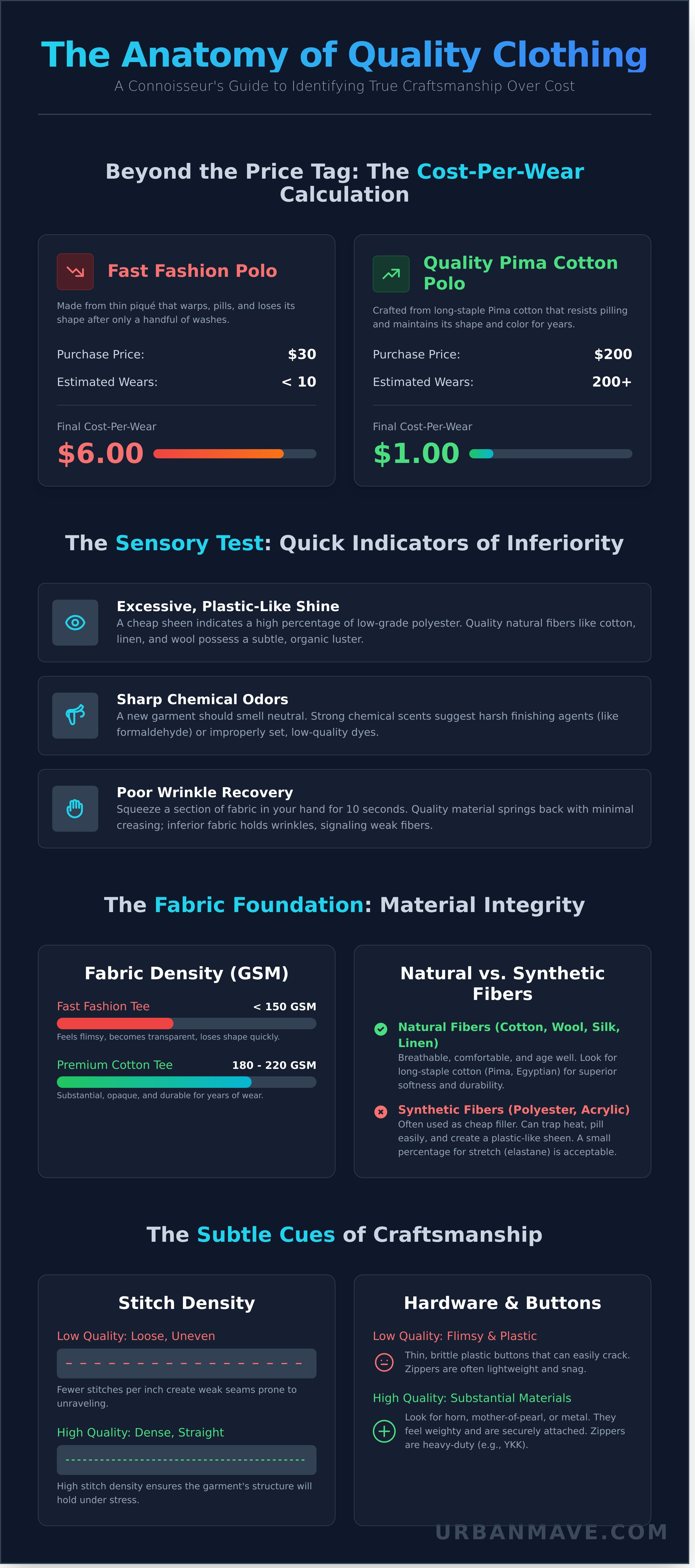
To visualize these differences, the following analysis provides a practical starting point.
This distinction is central to the concept of 'Quiet Luxury'. Fast fashion, by its very design, fails this test. Its purpose is fleeting relevance, not enduring style. Garments are engineered for a limited number of wears, often less than 10, before they lose their shape and integrity. We propose a different approach: the Sensory Harmony framework. This method trains you to evaluate clothing based on three pillars: Touch, Sight, and Structure. A deep appreciation for understanding textile basics is crucial here, as the material itself dictates over 70% of a garment's final quality.
The Cost-Per-Wear Mindset
True value isn't found on the price tag; it's calculated over a lifetime of use. A $30 fast-fashion polo, often made from a thin piqué that warps after five washes, has a cost-per-wear of $6. In contrast, a $200 polo crafted from long-staple Pima cotton may endure 200 wears, reducing its cost-per-wear to just $1. This isn't just an economic calculation. It's an environmental one. Choosing craftsmanship over consumption directly reduces your contribution to the 92 million tons of textile waste generated annually.
Immediate Indicators of Inferiority
Your senses can quickly identify poor construction before you even check the label. Look for these clear warning signs that betray a garment's low quality. These are the details that mass production overlooks, and learning them is a key part of how you spot high quality clothing.
- Excessive Shine: Natural fibers like cotton, linen, and wool have a subtle, organic luster. A cheap, plastic-like sheen in a blended fabric often indicates a high percentage (over 75%) of low-grade polyester used as a filler.
- Chemical Odors: A new garment should smell neutral. A sharp, chemical scent suggests the use of harsh finishing agents like formaldehyde to prevent wrinkling during shipping or poor-quality dyes that haven't been properly set.
- Lack of Recovery: Squeeze a section of the fabric firmly in your hand for 10 seconds. A quality material will have 'body' and spring back with minimal creasing. An inferior fabric will hold the wrinkles, signaling weak fibers that will lose their shape quickly.
Material Integrity: The Foundation of Every Great Garment
The true value of a garment begins with its fabric. Material integrity isn't just about the name on the label; it’s the purity, weight, and weave of the base fiber. This foundation dictates how a piece drapes, feels against your skin, and how it will endure over time. A superior design executed in a poor material will always fail. A simple design in an exceptional material becomes timeless.
Natural fibers almost always win the long game. Cotton, wool, silk, and linen possess a structural complexity that synthetics cannot replicate. They breathe, adapt to your body's temperature, and often develop a richer character with age. The key to learning how to spot high quality clothing lies in training your hands to recognize these differences. A long-staple cotton, like Egyptian or Pima, feels exceptionally smooth and has a subtle luster because its longer fibers create a stronger, finer yarn that resists pilling. High-twist wool, often used in quality suiting, feels dry and springy; when you clench it in your fist, it should release with minimal wrinkling, a testament to its resilience.
Pay attention to the fabric's weight, measured in Grams per Square Meter (GSM). This number indicates density and durability. For example, a premium cotton t-shirt will typically have a GSM of 180-220, giving it a substantial, opaque quality. In contrast, many fast-fashion equivalents fall below 150 GSM, feeling flimsy and losing shape after only a few washes. This tangible data point is a reliable indicator of longevity.
Natural vs. Synthetic: The 2026 Perspective
The difference between natural silk and a polyester mimic is immediate. True silk is lightweight yet strong, with a unique shimmer that comes from its triangular prism-like fiber structure. It's a natural insulator, feeling cool in summer and warm in winter. Polyester feels slick, often builds static electricity, and traps moisture against the skin. While synthetics have their place, a garment's quality is often revealed by how and why they are used. A small percentage of elastane (2-5%) in a pair of quality jeans or a jersey top isn't a compromise; it's a functional enhancement for comfort and shape retention. Premium Irish linen can be identified by its consistent, fine slubs and a distinct cool, crisp feel. It softens beautifully with every wash, a trait poor-quality, papery linen will never achieve.
Innovative Textiles: Lyocell and Beyond
Modern material science has produced exceptional, sustainable alternatives. High-grade Lyocell, particularly from the TENCEL™ brand, is a prime example. You can identify it by its fluid, silk-like drape and remarkable breathability; it's 50% more absorbent than cotton, making it ideal for all-season wear. Its closed-loop production process also reflects a commitment to sustainability. The rise of recycled luxury fibers, like regenerated cashmere, in designer goods is another hallmark of modern quality. For a deeper understanding of these textiles, the Urban Mave guide to Lyocell offers precise details on its properties. Similarly, a comprehensive guide to spotting quality clothing offers excellent visual references for a wide range of materials. Recognizing these fabrics is a critical skill for building a lasting wardrobe. Understanding these materials is the first step; the next is to explore them in precisely crafted garments, such as those in the Urban Mave essentials collection.
The Anatomy of Construction: Technical Markers of Excellence
A garment's true character is revealed not in its design, but in its construction. Beyond the surface, the technical details of how a piece is assembled determine its longevity and fit. Understanding these markers is fundamental to learning how to spot high quality clothing. These are the silent signatures of craftsmanship that separate the disposable from the durable.
Developing this eye for detail is a skill, much like in other specialized fields where durable equipment is essential. For instance, in outdoor pursuits, sourcing reliable gear from a specialist like Vse za Lov in Prosti Čas is key to ensuring performance and safety.
First, examine the stitching. A high stitch density is a primary indicator of strength. Look for a count of 10 to 12 stitches per inch (SPI) on key seams. This tight, clean line ensures the garment can withstand stress and movement. In contrast, fast-fashion pieces often use a lower density, around 5 to 7 SPI, resulting in seams that are prone to pulling apart. Next, inspect the seam allowance-the fabric inside the garment between the stitch line and the raw edge. A generous allowance, typically over 1.5 cm, signifies a luxury build. It allows for future alterations, extending the piece's usable life. It is an investment in adaptability.
Precision is another hallmark of excellence. On patterned fabrics, check for meticulous pattern matching. Stripes, plaids, and prints should align perfectly across seams, pockets, and plackets. This detail requires more fabric and highly skilled labor, making it a clear visual cue that no corners were cut. To assess seam integrity, perform a gentle 'Pull Test'. Grasp the fabric on both sides of a seam and pull lightly. A well-constructed seam will remain firm and flat, with no visible gaps or thread pulling. It's a simple, non-damaging way to test the garment's resilience.
Stitching and Seam Finishes
The interior of a garment reveals its quality. Look for clean finishing, where no raw fabric edges are visible. This prevents fraying and demonstrates attention to detail. French seams, where the seam allowance is enclosed within a second seam, are a sign of superior craftsmanship, often found in unlined silk shirts and fine blouses. While a standard overlocked edge is functional, it lacks this refined touch. Finally, check for reinforced stress points. Quality garments feature bar tacks or extra stitching at pocket corners, belt loops, and the crotch to prevent tearing.
Structure and Lining
In tailored pieces like jackets, structure is paramount. A full-canvassed jacket contains a layer of canvas stitched between the outer fabric and the lining, allowing it to mold to your body over time. A fused jacket uses glue, which can bubble and stiffen. Use the 'pinch test': if you can feel three distinct, floating layers on the chest, it's canvassed. The lining material is just as important. Premium options include:
- Bemberg (Cupro): A breathable, silky, and durable cellulose fiber.
- Silk: A natural, luxurious fiber known for its strength and feel.
These technical details are often overlooked by consumers, a challenge highlighted by research on communicating clothing quality from Aalto University. By learning to identify these markers, you move beyond surface aesthetics. You gain the knowledge of how to spot high quality clothing based on the integrity of its craftsmanship, not just its branding. This is the foundation of a truly timeless wardrobe.
Hardware and Finishes: The Subtle Cues of Craftsmanship
Fabric and fit are primary indicators of a garment's value. Yet, the small components-the hardware and finishing touches-provide the most honest account of its construction. These details are not afterthoughts. They are deliberate choices that reflect a commitment to longevity and function. Understanding these elements is essential for anyone learning how to spot high quality clothing.
Examine the buttons first. Mass-produced garments use molded plastic, which feels light, warm to the touch, and often has a subtle seam along its edge from the mold. In contrast, premium clothing features buttons made from natural materials. Mother-of-pearl has a distinct coolness and an iridescent luster that shifts in the light. Horn buttons, sourced as a byproduct, display unique grains and color variations. These materials are not just aesthetically superior; they are significantly more durable.
Zippers offer another immediate quality check. A flimsy, snag-prone zipper is a clear sign of cut corners. Look for established names engraved on the pull tab. Brands like YKK, a Japanese company founded in 1934, and the Swiss-made Riri, established in 1936, are benchmarks for quality. A premium zipper has a discernible weight and a smooth, uninterrupted glide. The teeth are polished and engage without resistance, a functional detail that ensures years of reliable use.
The finishing of openings and edges also tells a story. Look closely at a buttonhole. A high-quality garment will feature dense, clean stitching, often with a raised 'purl' on the edge that prevents fraying. This is a stark contrast to the sparse, loose threads common on fast-fashion pieces. Similarly, inspect the hem. A well-made trouser or skirt often uses a blind hem, where the stitching is nearly invisible from the exterior, creating a clean, uninterrupted line. A visible, rushed machine stitch is a hallmark of rapid, low-cost production.
Functional Details That Matter
Beyond the basics, certain functional details signal a heritage of true craftsmanship. These are small, intentional additions that elevate a garment from merely good to exceptional.
- Surgeon’s Cuffs: Working buttons on a jacket's sleeve are a traditional tailoring detail, historically allowing a surgeon to roll up their sleeves without removing their coat. While less practical today, their presence signifies a higher level of construction.
- Spare Components: A small fabric pouch containing a spare button is a thoughtful inclusion. It shows the maker anticipates the garment will be worn and cherished for years, long enough to require minor repairs.
- Hanging Loops: The presence of a locker loop on the back of a shirt collar or delicate ribbons inside a knit top is designed to help the garment maintain its shape when hung, preventing stretching at the shoulders.
The Weight of Hardware
The material composition of hardware is a definitive test. Plastic components feel light and room-temperature. Quality metal hardware, from clasps to buckles, feels cool and has a satisfying heft. This weight comes from using superior base metals. Premium accessories are typically crafted from plated brass, a dense and corrosion-resistant material. In contrast, 90% of low-cost hardware uses cheaper zinc alloys that can tarnish, chip, or break. This difference in material is not just about feel; it's about durability. For a clear example of this principle in practice, explore our collection of premium Italian hardware.
Building a Timeless Wardrobe: The Urban Mave Standard
The ability to identify superior craftsmanship is a skill. It transforms shopping from a seasonal task into a deliberate act of curation. This final step is about application: using your knowledge to build a wardrobe that is both functional and sophisticated. It moves beyond fleeting trends to embrace silhouettes with permanence. True style is not about what is new; it is about what endures. Knowing how to spot high quality clothing is the foundation for a wardrobe that serves you for decades, not just seasons.
Longevity depends on care. High-quality garments are an investment, and their lifespan is directly tied to their maintenance. For natural fibers, this means gentle treatment. Wash merino wool and cashmere in cold water, below 30°C, with a pH-neutral detergent and always lay them flat to dry. This prevents the fibers from stretching or shrinking. For structured pieces like a leather jacket, use a wide, padded hanger to support the shoulders and store it away from direct sunlight, which can dry out and fade the material. A small commitment to proper care ensures your pieces retain their integrity year after year.
The Minimalist Edit
A focused wardrobe begins with essentials. A precisely tailored knit polo or the perfect black shirt forms the core. We believe neutral palettes-charcoal, ecru, black, and navy-reveal the truth of a garment. They don't hide behind bold patterns, so the texture of the fabric and the precision of the stitching become the primary focus. This minimalist approach is central to creating a versatile and sophisticated look, as explored in The Smart Casual Edit: A Modern Guide.
The Urban Mave Commitment
Our philosophy is simple. We create and curate pieces for a modern, intentional lifestyle. Each garment is selected for its timeless design and superior construction, intended to integrate seamlessly into your life. We are transparent about our materials, from fine Italian leather to locally sourced textiles. This commitment to quality is our standard, a promise of enduring style and function. Discover the Urban Mave Collection.
Before any purchase, perform this 30-second scan. It’s a practical method that simplifies how to spot high quality clothing on the spot.
- Stitching & Seams: Look for dense, straight stitches-at least 10 per inch on woven fabrics. Check that interior seams are fully finished (flat-felled or French seams are excellent signs) and not raw or serged, which can fray over time.
- Fabric Feel & Recovery: Hold the fabric. It should have a substantial handfeel, not feel thin or flimsy. Gently crumple a section in your fist for 5 seconds. A quality natural fabric will have minimal creasing and smooth out quickly.
- Hardware & Details: Examine the buttons, zippers, and clasps. They should feel solid and secure. Zippers from brands like YKK or Riri indicate the maker didn't cut corners. Buttonholes should be neat and densely stitched.
- Pattern Matching: On patterned garments like striped shirts or plaid jackets, check that the patterns align perfectly at the seams, especially across the shoulders, pockets, and placket. This is a hallmark of meticulous craftsmanship.
Mastering the Art of a Timeless Wardrobe
True quality isn't defined by a price tag; it's revealed in the details. You now have the knowledge to assess the integrity of a fabric, the precision of a flat-felled seam, and the substance of custom hardware. This guide on how to spot high quality clothing is more than a set of rules. It's a new perspective-the ability to see the craftsmanship that others overlook.
Applying this standard consistently requires a trusted source. Urban Mave was founded on these exact principles of enduring quality and minimalist design. Each of our handpicked designer goods reflects a commitment to timeless sophistication. We extend this curated elegance worldwide with our global shipping service.
Shop our curated collection of high-quality essentials and begin building a wardrobe that is not just worn, but lived in. A wardrobe built with intention.
Frequently Asked Questions
Is 100% cotton always better than a blend?
No, 100% cotton is not always superior to a quality blend. Blends can enhance a fabric's performance and longevity. Adding 2-5% elastane to cotton provides necessary stretch and shape retention, crucial for fitted garments. A cotton-TENCEL™ Lyocell blend improves drape and moisture-wicking properties. The quality of the individual fibers and the blend's intended purpose determine its value, not the 100% natural composition alone.
How can I tell if a garment is high quality when shopping online?
To assess quality online, you must focus on detailed product descriptions and high-resolution imagery. Look for specifics like fabric weight (GSM), fiber origin, and construction notes. Quality brands provide zoom functions to inspect stitching and texture. Customer reviews from the last 6-12 months can also offer insight into long-term durability. This analytical approach is essential for learning how to spot high quality clothing without a physical inspection.
What does 'GSM' mean and why should I care about it?
GSM stands for 'Grams per Square Meter' and it measures a fabric's density and weight. This metric is a reliable indicator of durability and feel. For example, a quality t-shirt typically has a GSM of 160-220, feeling substantial and opaque, while a lightweight summer shirt might be 120 GSM. A higher GSM doesn't always mean better; it signifies the fabric's intended purpose. It's a precise tool for understanding a material's substance.
Do expensive designer brands always offer better quality?
No, a high price tag or a designer name does not guarantee superior quality. The price often reflects marketing costs, brand prestige, and design novelty, not just craftsmanship. Many direct-to-consumer brands offer equivalent or superior quality for 30-50% less by eliminating retail markups. True quality is found in the fabric, stitching, and construction details, which require careful inspection regardless of the brand label.
How do I spot high-quality wool without it being scratchy?
High-quality, non-scratchy wool is determined by the fineness of its fibers, measured in microns. Look for wool types known for softness, such as Merino, with a fiber diameter under 20 microns. Cashmere fibers are even finer, usually 14-19 microns. A lower micron count means a softer, more flexible fiber that won't irritate the skin. The fabric should also have a smooth, consistent surface without excessive pilling.
What are the signs of poor quality stitching to look out for?
Poor quality is evident in loose threads, uneven stitches, and a low stitch count. Inspect the seams closely. High-quality garments have a high number of stitches per inch (SPI), usually between 8 and 12 for most fabrics. Fewer than 7 SPI can indicate a weak seam prone to breaking. Also, check for mismatched patterns at the seams and crooked or inconsistent stitch lines. These details reveal a lack of precision in manufacturing.
Can a synthetic fabric like Lyocell actually be high quality?
Yes, modern semi-synthetic fabrics such as TENCEL™ Lyocell can be exceptionally high quality. Lyocell is derived from natural wood pulp through a closed-loop process, making it a sustainable choice. It's valued for its smooth drape, breathability, and impressive durability. Unlike cheaper synthetics, it resists pilling and feels soft against the skin. Its quality rivals many natural fibers, offering unique performance benefits that make it a premium material.
Why do some high-quality shirts have thick buttons?
Thick buttons on a quality shirt are a sign of superior materials and attention to detail. These are often made from mother-of-pearl or corozo, natural materials that are more durable than standard plastic. A thickness of 3-4mm provides a substantial feel and makes the button less likely to crack. This small detail reflects a commitment to using premium components, a key lesson in how to spot high quality clothing.


