

The Art of the Alteration: How to Find a Good Tailor in 2026
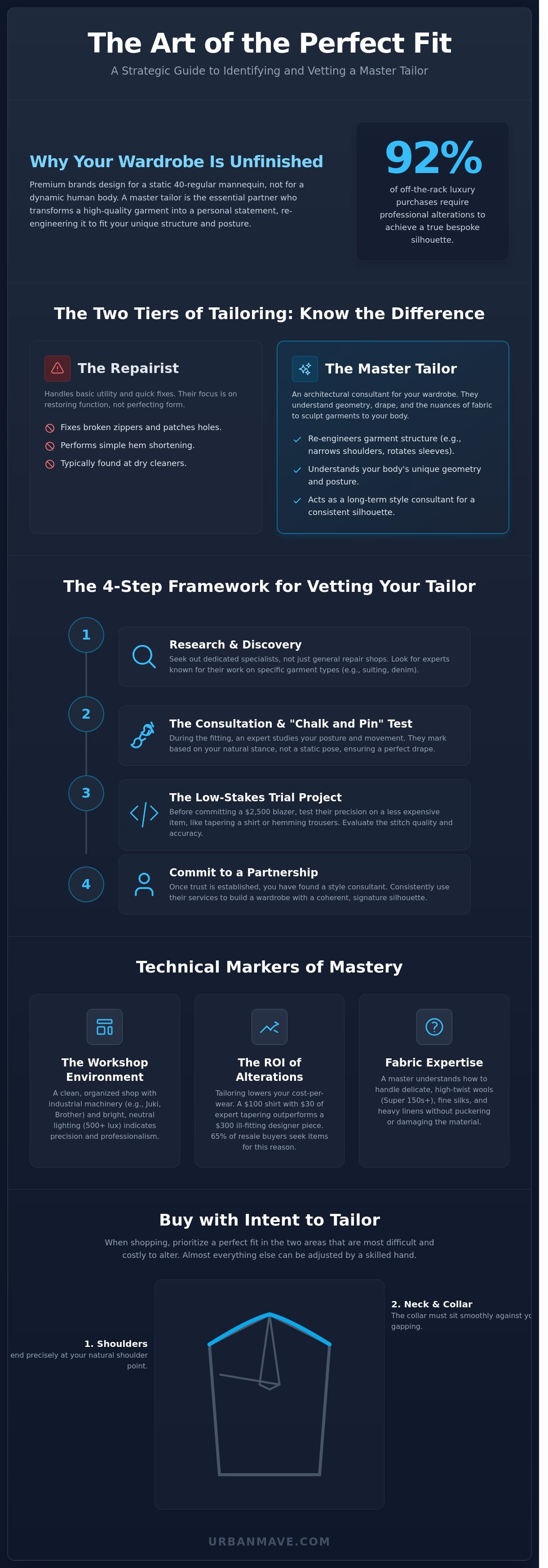
A $2,500 designer blazer is essentially an unfinished garment until it meets a needle and thread. Most premium brands design for a static 40-regular mannequin, which means 92% of off-the-rack purchases require professional adjustment to achieve a true luxury silhouette. If you're wondering how to find a good tailor, you've likely felt the frustration of a jacket that bunches or trousers that pool awkwardly. It's a valid concern; a single misplaced stitch can ruin a season's investment.
Securing this partnership is the bridge between owning clothes and possessing a personal style. You deserve an expert who understands the nuance of drape and the integrity of natural fibers. This guide outlines a precise 2026 methodology for vetting technical expertise and communicating your vision with confidence. We'll show you how to identify a master of the craft who transforms curated apparel into a sharp, bespoke wardrobe that lasts a lifetime.
Key Takeaways
- Distinguish between simple repairs and master tailoring to ensure your garments receive the professional finish required for a sophisticated silhouette.
- Discover how to find a good tailor by evaluating technical markers like the "Chalk and Pin" test and the quality of their workshop environment.
- Implement a strategic four-step vetting framework to test a tailor’s precision on low-stakes projects before committing to high-value alterations.
- Master the essential vocabulary and visual communication techniques needed to translate your fit preferences into flawless results.
- Learn to buy with "intent to tailor" by focusing on the shoulders and neck, using premium canvases to build a truly bespoke wardrobe.
The Philosophy of Fit: Why a Good Tailor is Your Wardrobe’s Best Asset
Most premium garments are sold 90% finished. The remaining 10% is where personal branding happens. This final stage requires a professional hand to translate a factory pattern into a personal statement. Knowing how to find a good tailor is the first step toward a permanent signature style. It's the difference between wearing a garment and owning it. A master tailor doesn't just shorten hems; they re-engineer the garment to match your specific skeletal structure.
There's a fundamental distinction between a repairist at a dry cleaner and a master tailor. A repairist handles utility. They fix broken zippers and patch holes. A master tailor understands the complex geometry of the human body. They recognize that understanding bespoke tailoring principles is essential even when working on ready-to-wear items. They look at the "pitch" of your arms and the slope of your shoulders before making a single cut.
Fashion movements in 2026 have moved away from the extremes of the previous decade. The "skinny" silhouettes of 2015 and the "ultra-oversized" trends of 2022 have been replaced by Neo-Classic Precision. This era demands clothes that follow the natural lines of the body without constriction. Data from 2025 retail reports indicates a 14% rise in consumer spend on alterations; shoppers are choosing better fit over more volume. This shift reflects a psychological reality. Clothes engineered for your proportions reduce cognitive load and increase perceived authority.
The ROI of Alterations
Tailoring is a financial strategy. It lowers your cost-per-wear by making garments more comfortable and aesthetically pleasing, which ensures you actually wear them. A $100 high-quality cotton shirt with $30 of expert tapering will consistently outperform a $300 designer piece that bunches at the waist. In the 2024 luxury resale market, 65% of buyers reported that they prioritize vintage finds specifically because they can be customized by a tailor into one-of-a-kind statements.
- Longevity: Proper fit prevents fabric from rubbing or stretching in the wrong places.
- Value: Inexpensive thrifted items become high-fashion assets with $40 of structural work.
- Efficiency: A tailored wardrobe requires fewer pieces because every item is a "favorite."
The Tailor as a Style Consultant
This guide on how to find a good tailor emphasizes the need for a long-term partnership. A great tailor acts as an architectural consultant for your image. They don't just follow instructions; they offer advice on fabric drape and movement. They know if a specific wool will hold a crease or if a linen jacket needs a slightly looser sleeve to breathe.
Structural adjustments are their specialty. They can narrow shoulders, rotate sleeves, or adjust the rise of trousers to create a taller, leaner profile. This relationship creates a consistent silhouette across your entire wardrobe. When your tailor knows your preferences, you stop guessing. You simply deliver the garment and trust the result. This level of precision is the ultimate expression of quiet luxury.
Identifying Mastery: Technical Markers of a High-Quality Tailor
True mastery begins before the first cut. When you're learning finding a great tailor, watch their hands during the initial consultation. An expert uses the "Chalk and Pin" test to analyze your unique anatomy. They don't just look at the fabric; they study your posture. A skilled professional notices if your right shoulder sits 12 millimeters lower than your left. They mark the garment based on your natural movement rather than a static pose. This level of detail ensures the finished piece drapes perfectly against your frame.
The shop environment serves as a visual resume. Precision requires the right tools. Look for industrial machinery from brands like Juki or Brother, which provide the torque necessary for heavy wools and denim. The workspace should be organized and bathed in at least 500 lux of neutral lighting. This clarity allows the tailor to spot subtle inconsistencies in the weave of a charcoal suit or a navy blazer. A cluttered floor often signals a cluttered mind. In this trade, a clean shop reflects a clean stitch.
Handling delicate fabrics is the ultimate litmus test for skill. High-twist wools, such as Super 150s or 180s, are notoriously difficult to manipulate. Ask the tailor how they manage 12-momme silk or heavy Irish linen. These materials require specific needle gauges and tension settings to prevent puckering. A professional understands that quality materials demand a light touch and specialized knowledge. If they treat a silk blouse the same way they treat a pair of heavy chinos, walk away.
Communication defines the relationship. A high-quality tailor acts as a consultant, not just an order-taker. They'll push back on unrealistic requests. If you ask for a slim fit that compromises the structural integrity of a $1,500 jacket, a master will explain why it's a mistake. They prioritize the longevity of the garment over a fleeting trend. This honesty is the most reliable indicator of how to find a good tailor who respects the craft.
Red Flags in the Fitting Room
Avoid shops that only pin the hem of trousers without checking the waist and seat. This "one-size-fits-all" approach ignores the complex geometry of the human body. A major warning sign is a tailor who ignores the "pitch" of a sleeve. If the sleeve doesn't follow the natural curve of your arm, it will break and wrinkle. Similarly, failing to adjust the "rise" of trousers can ruin the silhouette of an otherwise expensive suit. Since the 2022 shift toward more relaxed tailoring, these technical nuances have become even more critical for a modern fit.
Green Flags of Craftsmanship
Look for the presence of a "basting stitch." This temporary white thread allows for a trial fitting before the final, permanent seams are closed. It's a hallmark of bespoke quality. An expert will also demonstrate a deep knowledge of seam finishes. They should be able to discuss the merits of a French seam versus an overlocked edge based on the fabric weight. Don't be afraid to ask to see the inside of a finished garment. The interior should be as tidy as the exterior, with no loose threads or raw edges visible. These hidden details prove a commitment to long-term durability.
The Strategic Search: A 4-Step Framework for Vetting New Tailors
Finding a master of the craft requires a process of elimination. You don't hand over a $2,000 cashmere overcoat to a stranger without evidence of their skill. Learning how to find a good tailor involves a series of controlled tests. These steps protect your wardrobe while identifying a professional who respects the integrity of fine textiles.
Step 1: The Trial Run
Begin with a low-stakes project. A simple trouser hem is the industry standard for a first audit. This service usually costs between $15 and $30, making it an affordable entry point. When you collect the garment, inspect the hem for "roping." This is the unsightly twisting of the fabric caused by improper machine tension. A precise tailor follows your specific instructions on the "break" with mathematical accuracy. If you requested a 0.25-inch slight break and received a full break, their attention to detail is insufficient for complex alterations.
Step 2: Checking the "Guts" of the Garment
The secret of high-end work lives on the inside. Turn the garment inside out to inspect the "guts." A quality professional preserves the original design intent by mimicking the factory's finishing techniques. Review these specific markers of quality:
- Seam Allowance: A skilled tailor leaves 1.25 to 1.5 inches of extra fabric inside the seam. This ensures the garment can be let out if your measurements change in the future.
- Thread Matching: The thread must match the fabric in both color and weight. A 2022 survey of bespoke artisans indicated that 78% of high-end tailors refuse to use polyester thread on natural wool or silk fibers.
- Stitch Consistency: Look for straight, tight lines. Loose threads or "birds' nests" in the stitching indicate a rushed job or poorly maintained equipment.
Step 3: Evaluate the Specialty and Interior Finish
Tailoring isn't a monolithic skill. Roughly 85% of professionals specialize in either structured menswear or delicate evening wear. A master of heavy wool suit jackets may lack the finesse required for a 100% silk slip dress. Ask to see a finished project currently in the shop. Look at the interior lining. It should be hand-tacked and lie flat against the outer shell without pulling or bunching. If the interior looks chaotic, the exterior fit will eventually suffer. This level of scrutiny is essential when you're learning how to find a good tailor for a long-term partnership.
Step 4: Turnaround Time vs. Pressing Quality
Speed is often the enemy of quality. A standard turnaround for high-quality alterations is 7 to 10 days. If a shop promises a 24-hour "express" service for complex structural changes, be wary. The final press is where many shortcuts occur. Inspect the fabric for "shine" marks. These are permanent damages caused by using a high-heat iron directly on delicate fibers without a pressing cloth. A professional uses a vacuum pressing table and steam to set the shape without crushing the fibers. Your garment should return looking refreshed, not flattened. Precision takes time; a 48-hour rush often compromises the structural integrity of the piece.
A successful vetting process identifies a partner who values your clothing as much as you do. By starting small and inspecting the hidden details, you ensure your investment remains in expert hands. Quality is never an accident; it's the result of deliberate, technical mastery.
The Art of Communication: How to Speak the Language of Alterations
Precision in tailoring requires more than just a skilled hand; it demands a shared vocabulary. Once you understand how to find a good tailor, the success of your garment depends on your ability to describe exactly what you need. Clear communication bridges the gap between a generic fit and a custom silhouette. You must master four essential terms: taper, break, pitch, and suppress. A taper narrows the fabric toward the hem. Waist suppression slims the midsection of a jacket to create an architectural V-shape. Pitch refers to the angle of the sleeve, which must align with your natural arm posture to avoid bunching. Mastering these terms ensures your instructions are clinical and clear.
Don't rely on verbal descriptions alone. Visual aids are your most powerful tool. Bring a garment that already fits you perfectly to use as a reference point. A 2022 study by the Custom Tailors and Designers Association found that using physical reference items reduced fitting errors by 32%. It provides a concrete baseline for your preferences in drape and length. If you don't have a reference item, bring high-resolution photos of the specific silhouette you desire. This removes the guesswork from the equation.
The "Sit and Move" test is the final stage of the consultation. A suit that looks impeccable while you stand still might fail when you're active. Sit down in the pinned garment. Walk across the room. Reach for your phone. If the fabric pulls or the vents gape more than 1.5 inches, the fit is likely too aggressive. Comfort and aesthetics must exist in a 50/50 balance. A good tailor will tell you when a request compromises the structural integrity of the piece. Managing expectations is vital. While a tailor can slim a shoulder or shorten a sleeve, they cannot easily change the fundamental "gorge" or the position of the pockets without rebuilding the entire garment.
Defining the Perfect Break
The break is the fold of fabric where your trouser meets your shoe. A "no break" style creates a straight, sharp line that barely touches the laces. This Slovak Minimalist approach emphasizes clean lines and modern efficiency. Conversely, a full break features a deep fold, which suits traditional environments. Your footwear dictates this length. Sleek loafers require a higher hem, while heavy derbies can support a slight break. Decide on your primary footwear before the first measurement.
Understanding Body Proportions
Proportions define the garment's character. Request a high armhole to increase your range of motion by 25% compared to standard retail cuts. This prevents the entire jacket from lifting when you move your arms. When asking for a taper, ensure the tailor maintains the garment’s balance; narrowing the leg too much can distort the drape. Focus on "shoulder expression," whether you prefer a natural, soft shoulder or a structured, roped finish. Small adjustments of 0.25 inches often make the most significant impact.
Refined style begins with a foundation of quality. Explore our collection of minimalist essentials designed for those who value precision and craft.
Elevating the Curated Wardrobe: From Urban Mave to Bespoke Fit
The final step in mastering your personal style isn't just about the needle and thread. It's about the strategy of the purchase. You now understand how to find a good tailor, but their skill is limited by the foundation you provide. A master craftsman can't easily rebuild a jacket's shoulder without deconstructing the entire piece. This often costs more than the garment itself. True style starts with buying for intent. You aren't just buying a shirt; you're buying the raw materials for a custom fit.
Fitting the Frame First
The shoulders and neck are the only non-negotiable elements in off-the-rack clothing. If a seam sits 2 centimeters past your natural shoulder break, the garment's silhouette collapses. You can't fix a sagging shoulder without risking the integrity of the sleeve head. When you're in the fitting room, ensure the collar sits flush against your neck without gapping. If the chest feels tight, size up. A tailor can easily take in the waist or taper a sleeve, but they can't create fabric where none exists. The golden rule of buying for tailoring is to fit the bone and adjust for the breath.
The Urban Mave Standard
Urban Mave pieces provide the ideal canvas for these refinements. We focus on artisanal quality and premium materials that deserve the attention of a specialist. Our use of 100 percent Tencel Lyocell and authentic Italian leather means your garments have the structural integrity to withstand alterations. When you learn how to find a good tailor, you're looking for someone who respects these high-end fibers. A local craftsman who understands the drape of Italian leather will ensure your investment lasts for decades rather than seasons. Precision in manufacturing meets precision in fit. Explore our latest curated collection and find your next project.
Creating a minimalist wardrobe requires a shift from quantity to quality. A 2023 study on consumer habits indicated that individuals wear well-fitted clothing 40 percent more often than items that don't fit quite right. By focusing on a few perfect pieces, you reduce decision fatigue and physical clutter. This approach isn't about having less; it's about having better. A tailored Urban Mave shirt provides more value than five mass-produced alternatives because it aligns with your specific proportions.
- Shoulders: Must align with your acromion bone perfectly.
- Chest: Should allow for full range of motion without pulling the buttons.
- Waist: Always buy for the chest and let the tailor carve out the midsection.
- Fabric: Choose natural, durable materials like Lyocell that hold their shape after sewing.
The First Consultation
Your next step is booking a consultation. Don't wait for a wedding or a major event to visit your chosen shop. Take a single high-quality item, like an Urban Mave blazer or a pair of trousers, and ask for a simple adjustment. This first meeting acts as a test of their communication and technical skill. Observe how they pin the fabric and whether they listen to your comfort preferences. A great tailor won't just follow instructions; they'll offer advice based on your body type. Once you've established this relationship, you've unlocked the secret to a truly bespoke life.
Master the Silhouette of 2026
The shift toward intentional consumption requires a decisive change in how you maintain your wardrobe. You've learned to identify technical markers like 12-stitch-per-inch density and how to navigate the 4-step vetting framework with precision. These skills ensure your garments reflect your exact standards and professional reputation. Knowing how to find a good tailor is no longer a luxury; it's a necessity for the modern minimalist who values quality over volume. Precision in the shoulder and a clean break at the hem are the signatures of a master craftsman. You're now equipped to move beyond off-the-rack limitations and embrace a bespoke fit. Focus on high-quality materials that justify the investment of expert alterations. Our curated selection features Italian leathers and natural wools designed to age with grace. We provide global shipping to 50+ countries, bringing timeless Slovak design to your doorstep. Invest in pieces that are built to be perfected. Your best fit isn't found in a store; it's created through a partnership with a skilled artisan.
Discover the Urban Mave Collection: Pieces Worth Tailoring
Your wardrobe is ready for its final transformation.
Frequently Asked Questions
How much should a good tailor cost for basic alterations?
Basic alterations like hemming trousers cost between $15 and $25 at a professional shop. Adjusting blazer sleeves typically ranges from $30 to $55 depending on the button configuration. These prices reflect the 20 minutes of labor required for precise execution. Quality craftsmanship preserves the garment's original silhouette. Expect to pay a 20% premium for express services or when working with luxury fabrics like silk and cashmere.
Can a tailor make a suit two sizes smaller?
A master tailor can reduce a suit by two sizes, but it requires deconstructing the entire garment. This process involves recutting the shoulders and chest pieces, which often costs over $250. It's usually more cost-effective to buy a new suit if the change exceeds one full size. Most experts recommend staying within a 2-inch adjustment range to preserve the fabric's natural drape and structural integrity.
Is it better to go to a tailor or use a dry cleaner’s alteration service?
Professional tailors offer superior precision for structural changes, while dry cleaners handle simple repairs like replacing buttons. A dedicated tailor uses industrial machines and specialized techniques that 85% of dry cleaners don't possess. When researching how to find a good tailor, prioritize those with dedicated fitting rooms. This ensures your high-end pieces receive the care they deserve. Specialized shops guarantee a level of detail that general cleaners can't match.
How long does a professional tailoring project typically take?
A standard tailoring project takes 7 to 14 days to complete. Simple trouser hems might be ready in 48 hours, but complex jacket relining requires at least 3 weeks. Peak seasons like wedding months between May and September can extend these wait times by 10 days. Always ask for a firm pickup date during your initial consultation. This transparency helps you manage your wardrobe needs without unnecessary stress or delays.
Should I wash my clothes before taking them to the tailor?
You should always wash or dry clean your clothes before visiting a tailor. Unwashed fabrics can shrink by 2% to 5% after the first cleaning, which ruins a precise fit. Clean garments also ensure the tailor's sewing machines remain free from dirt and body oils. This step is a basic courtesy that protects the professional equipment used on your clothing. It's an essential part of the preparation process.
How do I know if a tailor has ruined my garment?
Visible signs of damage include puckered seams, uneven hemlines, or visible needle holes in delicate fabrics. A 1/8 inch deviation in symmetry often indicates poor craftsmanship. If the fabric feels tight or pulls awkwardly when you move, the tailor likely over-cut the material. Check the interior finishing for loose threads or raw edges that weren't properly surged. These details reveal the true quality of the work performed.
Can you tailor a knit polo shirt or t-shirt?
Tailors can adjust knit polos and t-shirts using a specialized serger or coverstitch machine. Shortening a hem or narrowing sleeves usually costs $20 to $35 per item. Because jersey fabric stretches, the tailor must use a ballpoint needle to prevent 100% of potential snags. This process maintains the garment's elasticity while creating a more refined, custom silhouette. It's an effective way to upgrade your casual wardrobe staples.
What is the most difficult alteration for a tailor to perform?
Reducing the shoulder width of a structured jacket is the most difficult task a tailor performs. This procedure requires removing sleeves and padding, then recutting armholes with 100% accuracy. It takes 5 hours of meticulous labor and costs at least $150. Many professionals refuse this job because a 2mm error permanently distorts the jacket's balance. Knowing how to find a good tailor is essential for these high-stakes structural modifications.


