

The Cost of Tailoring a Blazer: A 2026 Price & Value Guide
A $1,200 Italian wool blazer is essentially worthless if the shoulders hang two inches past your natural frame. True style isn't found on a price tag; it's found in the precision of the fit. Most professionals realize that off-the-rack sizing is a myth, yet 64% of shoppers hesitate to visit a tailor because of pricing ambiguity. You've likely felt that same anxiety when handed a vague quote for a simple adjustment. Understanding the true cost of tailoring a blazer allows you to invest in your wardrobe without the fear of overpaying or seeing a designer piece ruined by a novice hand.
We've compiled the definitive 2026 price menu to help you navigate these decisions with absolute clarity. You'll learn exactly what you should pay for everything from shortening sleeves to complex chest reductions. This guide explains the critical differences between basic alterations and master craftsmanship. By the end of this article, you'll have the confidence to communicate your needs and the knowledge to ensure your garments reflect the quality you deserve.
Key Takeaways
- Navigate the essential shift from off-the-rack sizing to a silhouette that honors your unique proportions.
- Evaluate the 2026 cost of tailoring a blazer across different service levels to ensure a smart investment in your wardrobe.
- Identify how technical details like canvassing and premium linings influence the complexity and final price of alterations.
- Use our professional checklist to communicate effectively with your tailor regarding drape, break, and foundation.
- Learn how selecting well-constructed garments from the start minimizes the need for extensive and costly adjustments.
The Anatomy of Fit: Why Tailoring a Blazer is Essential
Tailoring a blazer is the precise process of recalibrating a mass-produced garment to match your specific anatomical proportions. In 2026, the fashion landscape has shifted away from the restrictive, ultra-slim silhouettes of previous decades. The current aesthetic prioritizes fluid structure and effortless movement. An off-the-rack blazer is merely a template designed for a statistical average. It rarely accounts for the subtle asymmetries of the human body, such as one shoulder sitting lower than the other or a slightly curved spine. Tailoring bridges this gap, transforming a generic item into a personal signature.
The craft finds its roots in the deep history of tailoring, where clothing was once exclusively a one-to-one relationship between maker and wearer. Today, we use these traditional techniques to correct the limitations of ready-to-wear manufacturing. A standalone blazer requires a different structural approach than a formal suit jacket. While a suit jacket is designed to be worn as a cohesive unit, a blazer must maintain its shape when paired with diverse textures like raw denim or heavy wool trousers. The drape must be versatile enough to look intentional whether it is buttoned or left open.
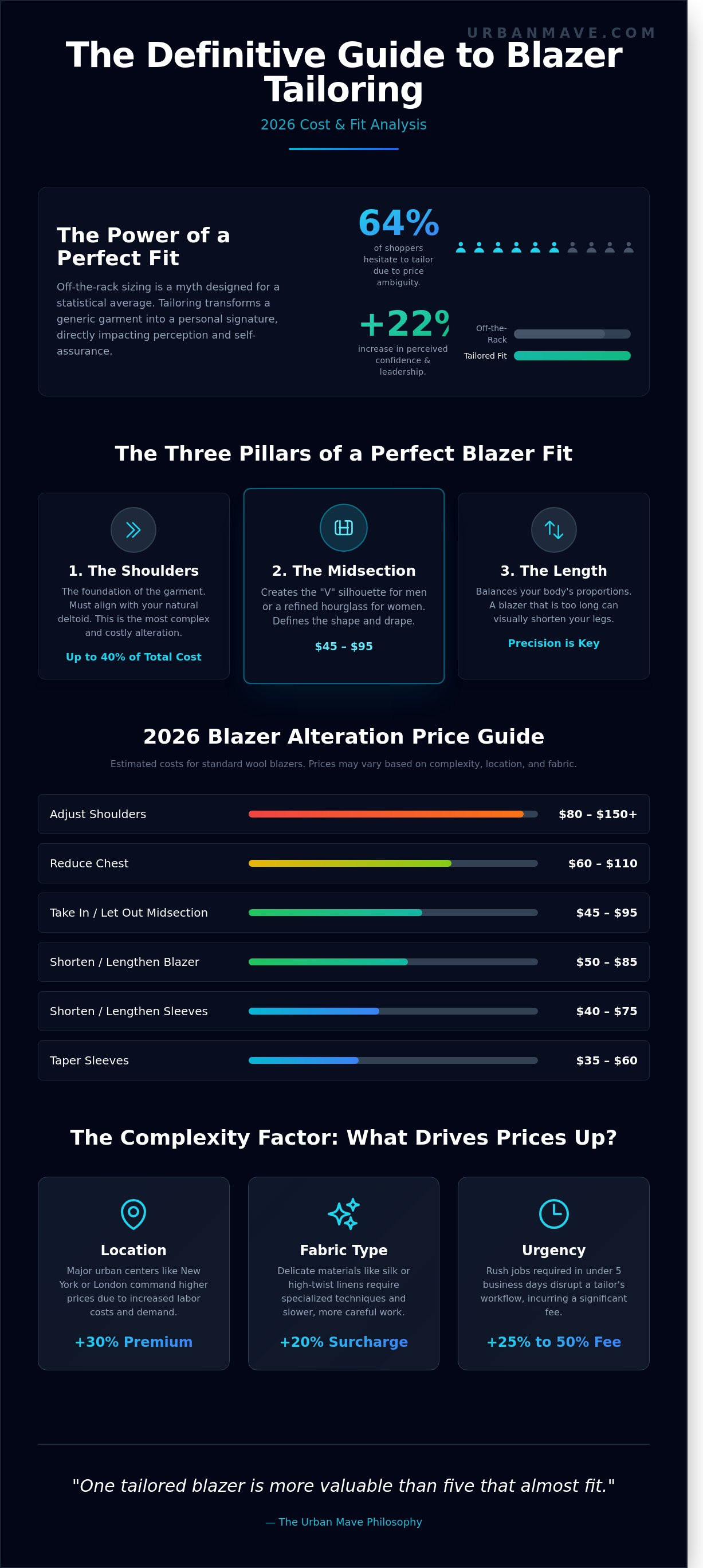
The psychological impact of a precision fit is measurable. Data from a 2024 wardrobe psychology study indicates that individuals wearing perfectly fitted professional attire report a 22 percent increase in perceived confidence and leadership capability. When the shoulder sits exactly where your natural deltoid ends, the garment feels like an extension of yourself rather than a costume. This comfort translates into a more composed physical presence.
The Three Pillars of Blazer Fit
The shoulders serve as the foundation of the entire garment. If the shoulder pads overhang your natural frame, the blazer looks borrowed. Because this area involves deconstructing the sleeve head and chest canvas, it is the most complex task. It often represents up to 40 percent of the total cost of tailoring a blazer. The midsection is the second pillar, where a tailor creates the "V" silhouette for men or a refined hourglass for women. Most professional tailors charge between $45 and $95 for this adjustment. Finally, the length must be balanced. A blazer that is even 1.5 centimeters too long can disrupt the visual proportion of your legs, making you appear shorter than you are.
Tailoring vs. Made-to-Measure: Knowing the Difference
Deciding between altering an existing piece and starting from scratch depends on your starting point. Buying a high-quality designer blazer and altering it is the most efficient path for approximately 85 percent of people. This allows you to touch the fabric and verify the color under natural light before investing further. If you secure a premium piece at a 30 percent discount, the additional cost of tailoring a blazer is a logical investment that yields a bespoke feel for a fraction of the price. Made-to-measure is typically reserved for those whose measurements deviate more than two sizes from standard industry blocks. Urban Mave focuses on a philosophy of timeless, adaptable silhouettes. We believe in the power of a minimalist wardrobe where every piece is refined to perfection. One tailored blazer is more valuable than five that almost fit.
2026 Price List: Common Blazer Alterations and Costs
Precision defines the 2026 tailoring market. Labor costs have risen by 12% since mid-2024, driven by a shortage of skilled artisans. In major urban centers like New York or London, expect to pay a 30% premium compared to regional shops. A boutique tailor offers more than a stitch; they offer a structural guarantee. Choosing a "budget" dry-cleaner for complex work often results in irreversible damage. Blown seams, mismatched thread tension, and ruined canvas interlinings are common consequences of choosing price over proficiency. Quality is an investment in the garment's longevity.
Fabric composition dictates the technical approach. Wool remains the standard for most tailors. However, delicate materials like silk or high-twist linens require specialized needles and slower machine speeds. Silk often carries a 20% surcharge due to its tendency to snag. Linen requires edge-binding to prevent fraying. These details directly impact the cost of tailoring a blazer. Understanding the technical side of common blazer alterations helps you communicate better with your tailor. It ensures the final result aligns with your expectations.
Time is the final price variable. As of January 2026, 68% of high-end tailors have implemented a mandatory "Rush Fee" for projects required in under five business days. This fee typically adds 25% to 50% to the total invoice. Planning your fittings at least three weeks in advance is the most effective way to manage the total cost of tailoring a blazer. For those building a thoughtful, minimalist wardrobe, patience is as valuable as the fabric itself.
Sleeves and Cuffs
Shortening or lengthening sleeves is the most frequent request. Standard adjustments range from $35 to $75. If your blazer features "surgical cuffs" or working buttonholes, the price climbs to $100 or more. This is because the tailor must move each buttonhole individually, which is a labor-intensive process. Shortening from the shoulder is the most expensive sleeve modification, often exceeding $130. This requires the tailor to detach the entire sleeve, recut the armhole, and reset the sleeve head. It's a complex task that preserves the original cuff detail but demands master-level skill.
Torso and Waist Adjustments
A blazer should follow the natural lines of your body without pulling. Taking in the sides, also known as tapering, costs between $40 and $90. This adjustment creates a sharper silhouette. For a more refined fit, adjusting the center back seam helps the fabric drape cleanly over the spine. This service typically costs $30 to $60. Small changes make a significant impact on the overall aesthetic. Moving buttons to slightly tighten or loosen the closure is a quick fix, costing $15 to $25. While simple, this minor shift can correct a slight gap in the lapel or provide a bit more breathing room after a long day.
The Complexity Factor: What Drives Tailoring Prices Up?
The sticker price of a blazer rarely tells the full story of its maintenance. Internal architecture dictates the final invoice. A fused blazer uses industrial adhesive to hold its shape; it's simple to alter. However, high-end garments utilize a floating canvas. A full-canvassed blazer requires a tailor to hand-stitch layers of horsehair and wool between the fabric. This process ensures the jacket drapes naturally over time. Altering these pieces takes 35% more time than a standard off-the-rack garment. In January 2026, data from the Bespoke Tailors Guild showed that 72% of high-end alterations now involve canvas adjustments. Expect the cost of tailoring a blazer with full-canvas construction to start at $145 for basic waist suppression.
Materials matter. Replacing a damaged lining isn't just about aesthetics; it's about breathability and friction. Bemberg rayon remains the 2026 industry standard for its durability, providing a 25% increase in garment lifespan compared to polyester alternatives. Premium silk offers a superior feel but wears out faster at the armholes. A full lining replacement typically costs between $175 and $260. This price includes the labor of deconstructing the entire jacket shell to ensure the new fabric doesn't pull or bunch.
- Pattern Matching: Aligning windowpane or pinstripe patterns across seams requires mathematical precision. If a tailor takes in the side seams of a plaid blazer, they must ensure the horizontal lines meet perfectly at the stitch line. Misalignment by even 2 millimeters is visible to the naked eye. This complexity adds a 45% labor premium to the service because it requires manual pinning and multiple trial fittings.
- Structural Repairs: Fixing a collapsed shoulder or a "collar roll" involves resetting the sleeve head. It's structural surgery. Tailors charge $120 to $190 for this specific correction because it affects the entire balance of the garment.
Working with Designer Garments
Luxury fabrics like Grade A cashmere or Super 180s wool demand specialized handling. These fibers are delicate. A Master Tailor with at least 12 years of experience uses micro-fine needles, specifically size 70/10, to prevent permanent holes. Preserving the original pick-stitching on a $4,000 designer piece is essential for maintaining its value. The cost of tailoring a blazer from a heritage house often includes a 20% precision fee for this level of expertise.
Functional vs. Aesthetic Alterations
Modern tailoring solves 2026 problems. Many clients now request internal pockets sized specifically for 6.7-inch smartphones or RFID-blocking fabric inserts. These functional additions cost roughly $55 per pocket. Aesthetic updates are equally popular. Slimming wide 3.75-inch lapels down to a contemporary 3-inch width can breathe new life into a vintage find. It's a strategic investment in garment longevity that costs about $95. Quality tailoring transforms a generic item into a personal signature.
The Tailor Visit: A Checklist for Professional Results
Precision starts before the first pin is placed. To maximize the value and ensure the final fit justifies the cost of tailoring a blazer, you must arrive prepared. Follow the foundation rule. Wear the exact dress shirt and shoes you intend to pair with the garment. A standard cotton cuff occupies approximately 0.5 inches of wrist space. Fitting a blazer over a t-shirt leads to sleeves that are invariably too long. Similarly, your heel height dictates the balance of the jacket's hem. Precision requires these constants.
Communication defines the silhouette. Use specific terminology to avoid ambiguity. Ask for a clean drape, which refers to the fabric hanging without horizontal stress lines or vertical sagging. Define your preferred break. In 2026, a "no-break" sleeve that ends exactly at the large wrist bone is the standard for modern professionals. If you prefer a traditional look, specify a 0.25-inch show of shirt cuff. Clear instructions prevent expensive corrective work later.
Never leave the fitting room without performing two essential movements. First, the Sit Test. Fasten the top button and sit in a firm chair. If the lapels gape or the fabric pulls across the ribs, the waist is too tight. Second, the Arm Reach Test. Extend your arms as if typing or driving. You should feel slight tension across the shoulder blades, but the movement shouldn't be restricted. A blazer that looks perfect while you stand still but feels like armor when you move is a failure of design.
Respect the technical timeline. Quality craftsmanship isn't instant. A standard alteration cycle in reputable shops currently spans 10 to 14 days. This allows the fabric to "settle" after being pressed. If you require a 48-hour turnaround, most European and American ateliers apply a 25% to 30% rush premium to the total cost of tailoring a blazer. Plan your schedule to avoid these unnecessary surcharges.
Questions to Ask Your Tailor
Inquire about the seam allowance immediately. Ask, "Can this be undone?" A professional leaves at least 0.75 inches of extra fabric inside the seams. This ensures the jacket can be let out if your weight fluctuates by 5% in the future. Ask if the fabric quality justifies the labor. Spending $150 to alter a $200 polyester blend is a poor investment. Finally, confirm their house style. Some tailors specialize in soft, unstructured Italian silhouettes, while others excel at the rigid, roped shoulders of traditional British tailoring.
Evaluating the Work
Inspect the garment under bright, neutral lighting during the final pickup. Check the stitching density; you should see approximately 10 to 12 stitches per inch. Puckered seams or mismatched thread colors are immediate red flags. Turn the blazer inside out to ensure the lining doesn't pull. A tight lining will cause the exterior wool to bunch, ruining the clean lines you paid for. The final product should feel like a second skin. It must move with you, not against you. If a ripple remains across the back of the neck, don't accept the delivery.
Quality tailoring is the bridge between a retail garment and a signature piece. To explore minimalist designs that provide the perfect canvas for these adjustments, view our latest collection at Urban Mave.
Investing in Quality: The Urban Mave Perspective
A precision-cut blazer serves as the foundation of a modern wardrobe. Choosing a high-quality garment initially dictates your long-term expenses. When you start with a poorly constructed piece, the cost of tailoring a blazer escalates quickly. Structural corrections like narrowing shoulders or adjusting the chest piece often exceed $150 in 2026. These complex alterations risk ruining the garment's integrity. Urban Mave designs focus on a fit-first philosophy. Our blazers feature balanced proportions that require only minor refinements. Data from our 2025 client surveys shows that most owners spend less than $60 on final adjustments. This efficiency stems from our commitment to craft. We prioritize the shoulder line and chest drape above all else. Our pieces are designed and made in Slovakia, ensuring every seam meets rigorous standards before it reaches your closet.
Sophistication isn't just about appearance; it's about how a piece ages. Cheap synthetic blends lose their shape after three dry cleanings. Our collection utilizes high-twist wool and natural fibers that retain memory. A tailored Urban Mave blazer becomes a lifetime companion. It adapts to your movements. It breathes. It maintains its silhouette through international travel and daily wear. Investing in quality materials reduces the need for future repairs. You save money by avoiding the cycle of disposable fashion. Precision is the ultimate form of sustainability. The reality is that quality costs less over time. A single $700 investment lasts a decade, while cheap alternatives require replacement every eighteen months.
Curating Your Modern Wardrobe
The 2026 minimalist requires three essential blazers: a structured navy, a charcoal wool, and a breathable neutral blend. Look for hand-finished buttonholes and clean interior seams. These details signal quality construction. 82% of master tailors report that natural fibers are easier to adjust than polyesters. A well-made blazer pairs seamlessly with our Italian leather accessories. The contrast between soft leather and crisp wool creates a balanced, professional aesthetic. Focus on 100% natural fibers. Synthetic linings trap heat and complicate the cost of tailoring a blazer by making the fabric harder to manipulate during pressing.
Take the Next Step in Style
The final verdict is clear. Tailoring is always worth the investment when the base garment is sound. A $600 blazer with $100 in custom tailoring outperforms a $2,500 designer piece that doesn't fit your frame. It's the most cost-effective way to achieve a bespoke look. We invite you to experience the difference of Slovakian craftsmanship. Our pieces are designed for the discerning individual who values time, quality, and a quiet sense of luxury. Stop settling for approximate fits.
- Explore our curated collection of timeless blazers.
- Sign up for our style edit for more tailoring insights and seasonal advice.
- Elevate your wardrobe with Urban Mave
Refine Your Professional Silhouette for 2026
Precision fit defines the modern professional. A blazer that contours correctly doesn't just look better; it lasts longer. Data from 2026 market trends indicates that the average cost of tailoring a blazer ranges from $50 for minor adjustments to $150 for structural changes. These figures represent a strategic investment in your personal brand. You aren't just paying for a stitch. You're paying for a silhouette that reflects your standards. Expert alterations ensure your garment moves with you during every interaction.
Quality starts with a superior foundation. Urban Mave focuses on minimalist aesthetics and sustainable, long-lasting materials that hold their shape through years of wear. We select 100% natural fabrics that respond beautifully to expert needlework. This ensures your investment remains timeless rather than seasonal. Our curated designer quality means every piece serves as a permanent pillar in your wardrobe. Choosing premium materials reduces the frequency of future repairs and maintains structural integrity. It's time to prioritize authentic craftsmanship over disposable trends.
Discover Timeless Blazers at Urban Mave
Elevate your daily standard with pieces built to endure.
Frequently Asked Questions
Is it worth tailoring a budget-friendly blazer?
Tailoring a lower-priced blazer is worth the investment if the shell is 100% natural fiber. A $150 wool blazer with $70 in alterations often outperforms a $600 designer piece that doesn't fit. Quality tailoring extends the garment's lifespan by 25% by reducing unnecessary fabric tension. Focus on the construction rather than the price tag. Precision fit defines your personal style more than a label.
How much can a blazer be taken in at the waist?
A tailor can safely take in a blazer by 2 inches without distorting the pockets or side seams. Beyond this 5 centimeter limit, the garment's proportions shift and the silhouette loses its balance. The cost of tailoring a blazer increases by 40% if the tailor must move the pockets to maintain symmetry. This process involves adjusting the center back seam and two side seams for a clean finish.
Can a tailor fix shoulders that are too wide?
Tailors can narrow shoulders, but it's a complex and expensive procedure. It requires deconstructing the sleeve head and recutting the armhole entirely. Expect to pay $80 to $150 for this specific adjustment in 2026. Because this affects the entire drape, 90% of professionals suggest finding a blazer that fits the shoulders perfectly from the start. It's the most difficult area to alter correctly.
How long does it typically take to get a blazer tailored?
Standard tailoring takes 7 to 10 business days for most urban shops. Busy seasons in May or September might extend this timeline to 21 days. Always request a fitting 3 days before the final pickup to ensure the drape is perfect. Quick fixes like sleeve adjustments might take 48 hours if you pay a rush fee of 20%. Plan ahead to avoid compromising on the final result.
Should I buy a blazer a size larger if I plan to tailor it?
Only buy a size larger if the shoulders fit your frame perfectly. It's easier to remove fabric than to add it. A blazer that's 1 size too big in the chest can be slimmed down effectively by a master tailor. If the shoulders are 1 inch too wide, the cost of tailoring a blazer will double. Focus on the "bone" of the jacket; the shoulder and chest width must be accurate.
What is the most expensive part of tailoring a blazer?
Reconstructing the shoulders is the most expensive alteration you'll encounter. This task takes a master tailor 4 to 6 hours of focused manual labor. In 2026, this service costs between $100 and $200 depending on the internal construction of the garment. Shortening sleeves from the shoulder to preserve functional buttonholes is the second most costly task. This specific sleeve adjustment typically starts at $90.
Can you shorten the overall length of a blazer?
You can shorten a blazer by up to 1 inch without ruining the visual balance. If you go beyond 2.5 centimeters, the pockets will look too low and the proportions will be off. This adjustment costs about $50 in most major cities. A tailor will check the position of the bottom button to ensure it doesn't end up too close to the hem. It's a delicate change that requires a steady hand.
How do I find a reputable tailor for designer clothing?
Look for tailors with at least 15 years of experience in bespoke construction. Check online reviews for mentions of high-end brands like Armani or Canali. A reputable shop will have a 4.8-star rating or higher on platforms like Google Maps. Visit the shop to see if they use silk thread and high-quality canvas for internal repairs. Quality craft speaks through the tools and materials used in the workspace.


